China Phone Number for Tourists 2026 — Get +86 (3 Ways)
China phone number for tourists 2026: travel eSIMs are data-only. Get a real +86 SIM for SMS, local apps, airport or carrier setup, or skip it on short stays.
Direct answer
Fast answer first, then the detail and edge cases below.
TL;DR
You don't need a Chinese phone number for Alipay or maps, but you'll want one by day three for food delivery, bike sharing, and WeChat Pay — get a tourist SIM at the airport for 150 RMB or try the free China Mobile offer.
- Not required
- Alipay, Amap, Didi, and hotel check-in all work with a foreign number. A +86 number unlocks Meituan, Dianping, and bike-share apps.
- Airport SIM
- Tourist SIM packages start around 150 RMB ($20) at airport counters with 20GB data, 80 minutes of calls, and a real +86 number.
- Free option
- Large China Mobile stores in tourist areas reportedly give free SIM cards to foreigners — up to 4 cards with 10GB each. Bring your passport.
- Best setup
- Use a travel eSIM for data and a local physical SIM for the +86 number. Domestic carrier eSIM is only practical on a short list of supported mainland-market phones.
Already have data sorted? This guide is specifically about getting a Chinese phone number (+86). For mobile data and eSIMs, see the eSIM guide.
Do you actually need a +86 number?
Probably not on day one. But by day three, you will wish you had one.
Here is the honest split:
What works WITHOUT a Chinese phone number
- Alipay — full setup and payments with foreign number
- Amap / Gaode — navigation works fine
- Didi — ride hailing works with foreign number (mostly)
- Google Maps via VPN — backup navigation
- WeChat messaging — basic chat works
- Hotel check-in — passport is enough
- Train tickets via Trip.com — no Chinese number needed
What gets much easier WITH a Chinese phone number
- Meituan (food delivery) — the standalone app often asks for +86 verification; Alipay/WeChat mini-programs are the workaround
- Dianping (restaurant reviews/bookings) — browsing works, but reviews, queues, and some coupons can hit account-verification weirdness
- Bike-share apps (Hellobike, Meituan Bikes) — need +86 for deposit and unlock
- 12306 (official train booking) — requires Chinese phone for SMS verification
- WeChat Pay full features — bank card linking and some transfers need +86
- Robot taxis — PonyPilot+ registration is much smoother with a local number
- Some metro apps — city-specific transit apps sometimes require +86 for QR ticket
- Luckin Coffee app — ordering ahead requires Chinese number (but you can scan in-store)
The short version: if you are here for 1-2 days and sticking to tourist basics, skip it. If you are staying 3+ days and want food delivery, bike sharing, robot taxis, or anything beyond the foreigner-friendly apps, get a SIM. Once your +86 is live, go install the apps that actually need it — Meituan, Dianping, and bike-sharing stop fighting you once the number is local.
Option 1: Buy a tourist SIM at the airport (easiest)
Most major airports have SIM counters right in the arrivals hall. Shenzhen Bao'an Airport has them. So do Beijing, Shanghai, and Guangzhou.
What to expect:
- Staff are used to foreigners — the process takes 10-15 minutes
- Bring your passport (mandatory — China requires real-name registration for all SIM cards)
- Prices are higher than city stores, but you save the hassle of finding a telecom shop
Typical airport prices (2026):
| Carrier | Data | Calls | Duration | Price |
|---|---|---|---|---|
| China Mobile | 20GB + 80min | 30 days | 150 RMB (~$20) | |
| China Mobile | 30GB + 200min | 30 days | 200 RMB (~$27) | |
| China Unicom | 40GB + 500min | 30 days | 250 RMB (~$34) | |
| China Telecom | 30GB + 500min | 30 days | 300 RMB (~$41) | |
| China Unicom | 100GB + 700min | 60 days | 500 RMB (~$68) |
All tourist SIM cards come with 5G support and hotspot capability. Do not assume an airport counter can activate a domestic eSIM: the official setup requires a supported mainland-market phone and an in-person carrier-store identity check. A physical SIM is still the safe default.
Payment: Cash (RMB) or Alipay/WeChat Pay if you already have it set up. Some counters accept foreign cards. Bring cash as backup.
Option 2: Ask about the free China Mobile SIM, but do not count on it
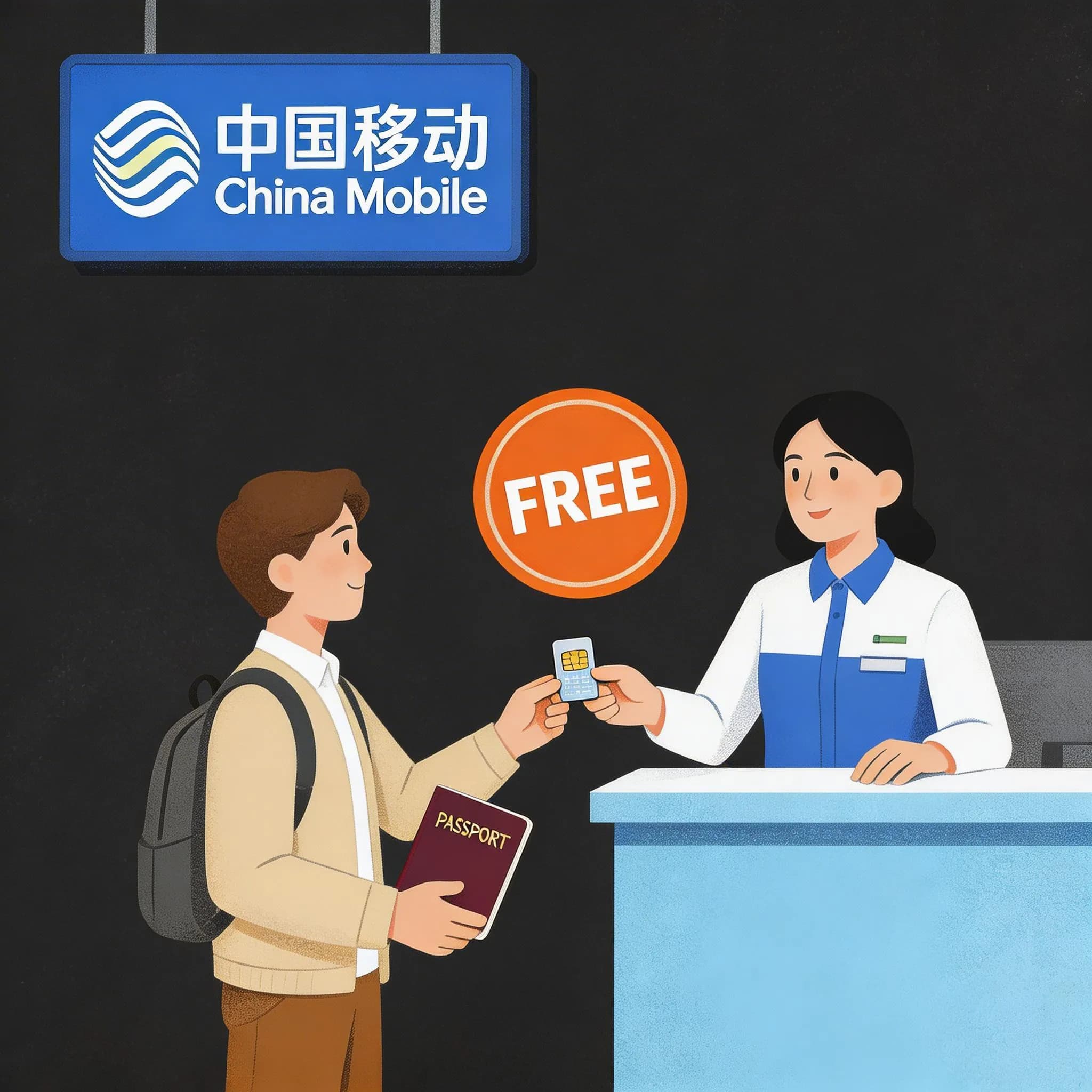
Multiple travelers in late 2025 reported that large China Mobile stores in tourist areas gave out free SIM cards to foreign tourists. I rechecked this in June 2026 and could not find an official China Mobile page promising the promo, so file this under "ask politely if you are already in the store," not "build your arrival plan around it."
What you reportedly get:
- Up to 4 SIM cards per passport
- 10GB data per card (40GB total if you get all four)
- A real Chinese phone number (+86)
- Full local 4G/5G speeds
Where to find it:
- Large China Mobile retail stores (not small kiosks or airport counters)
- Tourist zones in major cities — look for the big China Mobile flagship stores
- Ask specifically for the "tourist promotion" or show the Chinese text: 境外来华人员免费SIM卡
Requirements:
- Passport (for real-name registration)
- Being a foreign tourist (they check your passport nationality)
Caveats:
- This is not officially promoted on China Mobile's website — availability varies by store and city
- Staff may not know about it. Ask for a manager or younger staff member
- The cards only work inside China
- Not every store participates — you may need to try 2-3 locations
Our take: If this works, great. A free +86 number plus 10GB of data beats any paid tourist SIM. But do not count on it — have the airport counter or a paid carrier-store plan as your real backup.
Option 3: Walk into a telecom store in the city
Any China Mobile, China Unicom, or China Telecom store can sell you a prepaid SIM card. There are dozens across Shenzhen.
The process:
- Walk in with your passport
- Tell them you want a prepaid SIM card (预付费手机卡 — yù fù fèi shǒu jī kǎ)
- Choose a plan (they will show you options)
- They scan your passport and take a photo of you holding it
- Real-name registration is completed on the spot
- SIM is activated within minutes
City store prices are lower than airport — expect 100-200 RMB for a 30-day tourist package.
The challenge: Most staff at neighborhood stores speak minimal English. Use your phone's translation app, or show them this:
我是外国游客,想买一张预付费手机卡,带流量和中国手机号。请问有什么套餐? (I am a foreign tourist. I want to buy a prepaid SIM card with data and a Chinese number. What packages do you have?)
Which carrier to choose:
- China Unicom — best English support, widest phone compatibility, good for iPhones
- China Mobile — largest network, best rural coverage (matters if you leave Shenzhen)
- China Telecom — strong in southern China (including Shenzhen), but CDMA network can cause compatibility issues with some foreign phones
For most Shenzhen visitors: China Unicom or China Mobile. Both work perfectly in the city.
The 2026 carrier eSIM exception (probably not for your phone)
China's three carriers do offer smartphone eSIM now. This is a real local line — calls, SMS, data, and a +86 number — not a data-only travel plan.
The catch is the phone. Apple currently lists only the mainland iPhone Air (A3518) and iPhone 17e (A3635) for mainland carrier profiles. Other iPhones, including models bought overseas, cannot install them. Activation also happens at a carrier store with government ID or a passport.
So yes, a Chinese eSIM with a phone number exists. No, it is not the shortcut most tourists are searching for. Unless you own a supported mainland-market phone, buy the physical SIM and move on with your day.
Option 4: Skip the Chinese number entirely (workarounds)
If you decide the hassle is not worth it, here are the workarounds for the apps that "require" a Chinese number:
Meituan food delivery — Try the mini-program route first. Search "美团外卖" inside Alipay or WeChat. It is less smooth than the standalone app, but it often avoids the full account setup wall. The interface is in Chinese, so use translation screenshots and ask your hotel to type the address.
Dianping restaurant reviews — Browse restaurant photos and ratings through the Dianping website or WeChat mini-program. You cannot make reservations without a Chinese number, but you can see ratings and photos to decide where to walk in.
Bike sharing — Use Meituan Bikes through the Alipay mini-program. Some cities allow Alipay-based unlock without a separate app account.
Train tickets — Use Trip.com instead of 12306. Slightly higher fees (~10-20 RMB markup per ticket) but no Chinese phone number required.
Luckin Coffee — Walk in and scan the counter QR code to order. No app account needed.
The pattern: Alipay mini-programs bypass many Chinese-number requirements. If you have Alipay set up with a foreign number, you can access a surprising number of services through it.
The dual-SIM strategy (recommended for 3+ day stays)
If your phone supports dual SIM (most modern smartphones do), here is the setup that gives you the best of both worlds:
SIM slot 1 (or eSIM): Your travel eSIM (Airalo, Holafly) — handles data, bypasses the Great Firewall, keeps Google/WhatsApp/Instagram working
SIM slot 2 (physical): Chinese SIM card — gives you the +86 number for local app registrations, backup data on Chinese network
Configure your phone:
- Set the eSIM as your primary data connection
- Set the Chinese SIM for calls and SMS
- When you need to verify a Chinese number, switch briefly to the Chinese SIM for the SMS
This way you get unrestricted internet (via eSIM) plus a Chinese number (via local SIM) without choosing between them.
How to top up your Chinese SIM
Your prepaid balance will run out. Here is how to add credit:
- Alipay — open Alipay, search "充值" (top up), enter your +86 number, choose an amount (10/20/50/100 RMB), pay
- WeChat — same process in WeChat Pay
- Telecom store — walk in, show your number, pay cash
Alipay top-up is the easiest if you already have it set up. Takes 30 seconds and credit arrives instantly.
FAQ
Can I keep using my Chinese SIM after I leave China?
No. Tourist SIM cards only work on Chinese networks inside China. Once you leave, the SIM goes dormant. If you return to China later, the SIM may have been deactivated — check with the carrier or just buy a new one.
Will a Chinese SIM card work with my phone?
Almost certainly, if your phone is unlocked. China uses standard GSM/LTE bands. iPhones, Samsung Galaxy, and most Android phones work fine. If your phone is carrier-locked to your home provider, contact them to unlock it before your trip.
Can I receive international calls on a Chinese SIM?
Yes, but it costs extra. Tourist prepaid plans include some call minutes, but international incoming calls may incur charges. Tell people to reach you on WeChat or WhatsApp instead.
Do I need to turn off my Chinese SIM when using my VPN?
No. Your VPN runs over your data connection (eSIM or WiFi). The Chinese SIM can stay active for calls and SMS. However, if you are using the Chinese SIM for data and your VPN is on, some Chinese apps like Alipay may detect the VPN and act up. The dual-SIM strategy above avoids this — use the eSIM for data (with VPN) and the Chinese SIM only for calls/SMS/verification.
Change Log & Review CadenceExpand
Facts reviewed
Jul 14, 2026
Content updated
Jul 14, 2026
First published
Mar 18, 2026
Next review target
Aug 13, 2026