Best eSIM for China 2026 — Compare Plans Before You Fly
Best eSIM for China 2026: compare travel plans, hotspot limits and phone compatibility. Check what a China eSIM for tourists includes before buying your plan.
Direct answer
Fast answer first, then the detail and edge cases below.
TL;DR
Buy and install an eSIM before you fly. Airalo is the easiest all-round pick, Holafly is the simpler unlimited-data option, Nomad is the budget choice, and 3-5GB is enough for most one-week Shenzhen trips.
- Best all-round pick
- Compare Airalo’s current plan details, including data allowance, validity, network and top-up options, before paying.
- Unlimited-data pick
- Holafly is easier if you do not want to track usage, but its fair-use policy can temporarily reduce speed for up to one day.
- Budget pick
- Nomad's current China page lists China Unicom and China Telecom, with fixed-data plans that often cost less than comparable Airalo options.
- When to install
- Install the eSIM profile before boarding and switch it on once you land instead of trying to fix connectivity at the airport.
- How much data
- Plan on 3-5GB for a week of maps, rides, payments, and messaging. Buy a little more than you think you need.
- Does eSIM work in China
- Yes. Travel eSIMs connect through Chinese partner networks. Domestic carrier eSIM also exists, but only on supported mainland-market phones with in-store activation; overseas iPhones cannot install mainland carrier profiles.
The 30-second answer
Get Airalo before you fly. Buy a 5-10GB fixed-data plan and install it at home, then switch it on after you land. That covers most travelers.
Need a +86 phone number too? The destination-specific China plans from Airalo, Holafly, and Nomad are data-only. Keep the travel eSIM for data, then follow the China phone number guide for a local line. For almost every visitor that still means a physical SIM; mainland carrier eSIM only works on a short list of mainland-market phones.
Need unlimited-style data? Holafly starts at $11.90 for 3 days on the July 2026 price check — but its fair-use policy can temporarily reduce speed, so "unlimited" is more of a vibe than a guarantee.
Staying 30+ days? Math flips — compare Airalo, Nomad, and Saily inside the apps that week. Long-stay pricing moves around too much to memorize.
What you should NOT do: wait until landing to solve basic data. A domestic carrier line still means a counter, passport registration, and a phone-compatibility check. Buy travel data before you fly, then add a local number only if your trip actually needs it.
Why You Need an eSIM (Not Just Your Home Plan)
Option A — Roaming on your home plan: Check your own carrier’s China allowance, daily charge and fair-use limit. Compare that total with a travel eSIM before buying another plan.
Option B — Buy a local Chinese SIM: A local SIM may be useful if you need a +86 number. Ask a carrier store which packages and identity checks apply to your passport and phone; compare the setup time with what you actually need during the visit.
Option C — eSIM (Recommended): Buy online before you leave, install on your phone, activate when you land. No physical SIM swap. Read the plan’s activation instructions, including when validity starts, and save them offline.
China Supports Phone eSIM Now — With a Very Narrow Catch
The old answer was "China does not do phone eSIM." That stopped being true in October 2025, when China Mobile, China Unicom, and China Telecom launched smartphone eSIM service nationwide.
Here is the annoying part: the carrier profile is tied to a tiny supported-device list. Apple's current mainland-China support page lists the mainland iPhone Air (A3518) and iPhone 17e (A3635). It explicitly says other iPhones — including ones bought outside mainland China — cannot install a mainland carrier's eSIM profile.
Activation is not remote, either. You take the supported phone to a carrier store, show government ID or a passport, and staff activate the line. That line can include calls, SMS, data, and a real +86 number. It is not the same thing as an Airalo, Holafly, or Nomad travel eSIM.
What this means for you: if you are arriving with a normal overseas phone, treat mainland carrier eSIM as unavailable. Buy a travel eSIM for data. If you later decide you need a +86 number, get a physical local SIM. If you happen to own one of the supported mainland models, ask the carrier store about eSIM instead (you are the exception, not the plan).
Does eSIM Work in China?
Short answer: yes, with one clarification.
Travel eSIMs from Airalo, Holafly, Nomad, and Saily work on China's mobile networks through local carrier partners. You'll get 4G/LTE and often 5G in major cities like Shenzhen, Guangzhou, Beijing, and Shanghai.
Mainland carrier eSIM also works now, including for passport holders, but only on supported mainland-market devices and only after a carrier-store identity check. Owning an eSIM-capable iPhone from the US or Europe is not enough; Apple says those phones cannot install mainland carrier profiles.
The practical takeaway: buy your eSIM from an international provider before you fly. Don't plan on sorting it out after you land. The App Store and eSIM provider websites may load slowly or be partially blocked behind China's firewall.
What to Look for in a China eSIM
Not all eSIMs work the same in China:
| Feature | Why It Matters |
|---|---|
| Network partner | Check the named carrier partner and coverage for your itinerary |
| Data cap vs unlimited | Read the plan’s fair-use policy, including any speed reductions |
| Validity period | 7-day, 15-day, or 30-day options — match to your trip |
| VPN compatibility | Some plans route through Hong Kong servers and bypass the firewall natively |
| Hotspot included | If you need to tether to a laptop |
Top Picks: China eSIM 2026
Airalo — Best All-Round Pick
Airalo is the largest global eSIM marketplace. China carrier partners can vary by plan, so open the plan details before buying instead of trusting a blog table from three months ago.
What to check before buying:
-
A 5-10GB fixed-data plan for normal trips
-
5G/LTE support in China
-
Hotspot allowed
-
Whether the plan routes through Hong Kong or still needs your VPN
-
Network: Check current plan details — carrier partners can change
-
Speed: Fast, 5G where available in Shenzhen
-
VPN: Compatible. Note: some Airalo China plans route through HK servers and bypass the firewall natively — ask support to confirm before buying
-
Hotspot: Yes, included
-
Best for: Most travelers — flexible plans from short weekend trips to month-long stays
Holafly — Best for Unlimited Data
Holafly offers unlimited-style China data plans — good for heavy users or those who want simplicity.
Pricing (July 2026 official price check):
| Duration | Price |
|---|---|
| 3 days | $11.90 |
| 7 days | $27.50 |
| 15 days | $50.50 |
| 30 days | $73.90 |
- Network: Check current plan details before buying
- Speed: 5G/4G/LTE where available; Holafly says fair-use reductions can apply temporarily for no more than one day
- VPN: Compatible
- Hotspot: Available on most plans (check before buying)
- Best for: Travelers who want unlimited without tracking usage
SimOptions — Worth Considering
SimOptions currently lists China Unicom for its China plans. Pricing and availability may vary — check the plan details before purchasing because partners can change.
- Network: China Unicom 4G/5G, based on the current SimOptions China page
- Coverage: Available across major cities including Shenzhen
- VPN: Works with your own VPN app
- Hotspot: Included
- Setup: QR code install, straightforward
Nomad eSIM — Best Budget Option
Nomad (nomadesim.com) is a solid budget pick that keeps showing up in traveler recommendations. Their current China plans list China Unicom and China Telecom.
- Network: China Unicom 5G / China Telecom 4G, based on the current Nomad China page
- Plans: Multiple data/duration combos — check their site for current pricing (typically competitive with Airalo)
- VPN: Compatible with your own VPN app
- Hotspot: Included
- Setup: QR code install, straightforward
- Best for: Budget-conscious travelers who've used Nomad before, or anyone who found them via Reddit
Nomad doesn't have the slick app experience of Airalo, but their plans work and the pricing is often a few dollars cheaper for equivalent data. If you're choosing between Nomad and Airalo for a basic 7-day plan, either will get the job done.
Saily by NordVPN — Best for VPN Users
Compare Saily’s China plan on its own data allowance, validity and device requirements.
- Coverage: Available for China
- Setup: Check the Saily app and plan instructions; a VPN subscription is a separate product
- Price: Varies, check current rates
eSIMs That Include Firewall Bypass
Some eSIM providers route their traffic through Hong Kong or other non-mainland servers, meaning you can access Google, YouTube, and other blocked sites without a separate VPN. This is a significant convenience.
Compare the plan’s routing, price and hotspot allowance before buying. Access can differ between mobile data and hotel WiFi.
Ask the provider explicitly: "Does this eSIM route through Hong Kong / bypass the Chinese firewall?" before purchasing.
How to Set Up Your eSIM
Before You Leave Home
Step 1: Check eSIM compatibility Your phone must support eSIM. Most iPhones from iPhone XS onwards, and most flagship Android phones (Samsung S20+, Google Pixel 4+) support eSIM.
To check on iPhone: Settings → General → About → look for "Available SIM" or "Digital SIM"
Step 2: Purchase your eSIM Buy via the Airalo or Holafly app/website. Choose your plan and complete payment.
Step 3: Install the eSIM profile You'll receive a QR code or direct install link. Follow the prompts to add the eSIM to your phone.
On iPhone: Settings → Cellular → Add eSIM → scan QR code
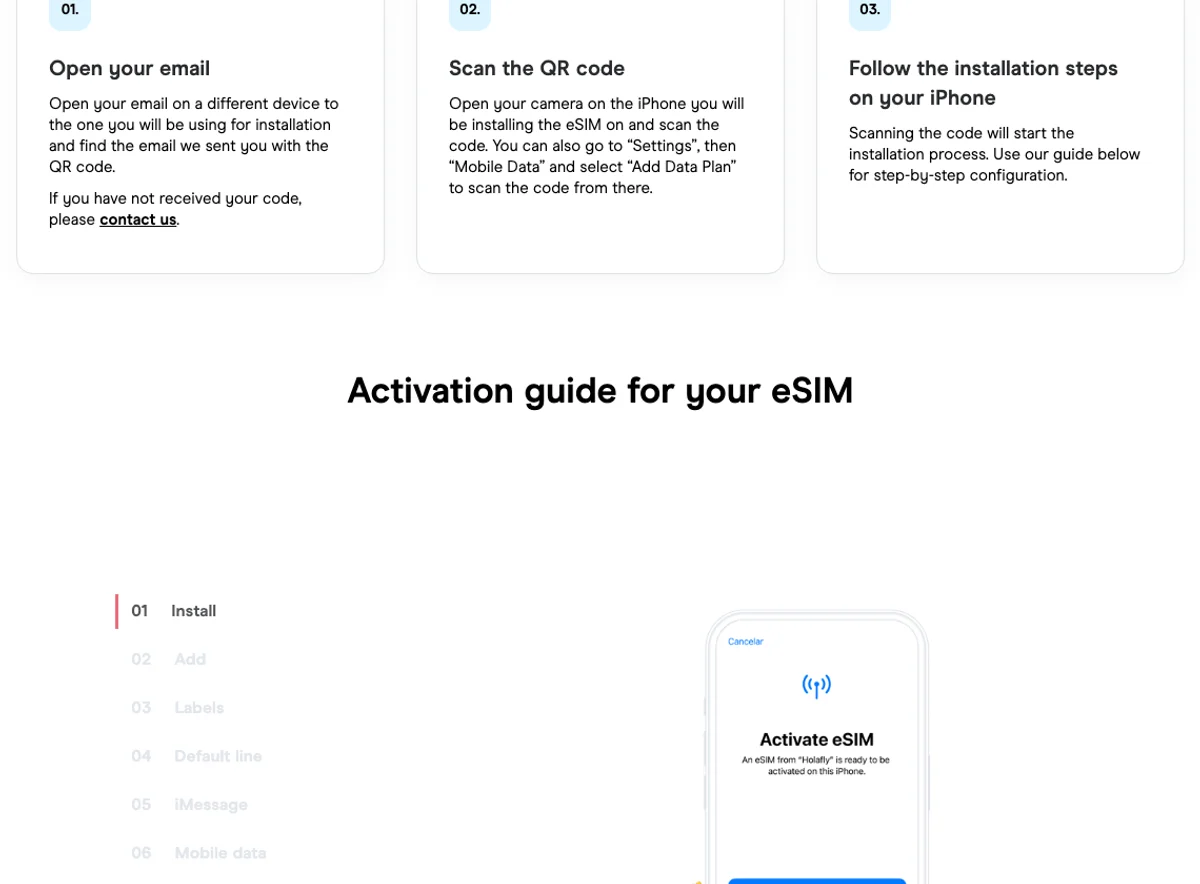
This is the part people mess up: the QR code usually needs to be open on a second screen. Do it at home on WiFi, not next to the Bao'an baggage belt with 4% battery.
Step 4: Configure but DON'T activate yet Install the profile but keep your current SIM as primary for now. You don't need to switch until you land.
At the Airport or Upon Arrival
Step 5: Activate the China eSIM Once you land, go to Settings → Cellular → select your China eSIM → toggle it on.
Step 6: Set data routing iPhone: Settings → Cellular → Cellular Data → select your China eSIM
You should see data bars within 1–2 minutes.
Data Usage Estimates
| Activity | Data per hour |
|---|---|
| Amap navigation | ~30MB |
| Alipay / WeChat Pay | Minimal (under 5MB/day) |
| Streaming music | ~60MB |
| YouTube (480p) | ~300MB |
| Video calls (WhatsApp) | ~200MB |
| VPN overhead | +10–20% on all usage |
For a 7-day trip: 3–5GB is sufficient for most people (navigation, messaging, some browsing). Heavy users or those streaming video: go unlimited or 10GB+.
If Your Phone Doesn't Support eSIM
Options:
- Rent a portable WiFi device (available at Shenzhen airport or ordered to your hotel) — one device shares data with all your devices via hotspot. Confirm the rental price, pickup and return arrangements before booking
- Buy a physical SIM at the airport — available from China Mobile and China Unicom counters at Bao'an airport. Bring your passport.
- Use hotel WiFi — reliable in most hotels but not useful when you're out
China eSIM with Phone Number
This is the most common point of confusion: the destination-specific China plans we rechecked from Airalo, Holafly, and Nomad are data-only. You get internet access, but you do NOT get a Chinese phone number (+86).
Why this matters: verification requirements differ by app, account and service. Try the available country-code and login options first. A data-only eSIM cannot receive SMS for a +86 number.
The dual-SIM strategy (recommended for stays of 3+ days):
- Slot 1: Travel eSIM → your data connection (Airalo, Holafly, Nomad)
- Slot 2: Local Chinese SIM → usually a physical SIM from a carrier counter → gives you a +86 number for app registrations
This way you get both: reliable data from your pre-installed eSIM, plus a local number for apps that require it. See our Chinese phone number guide for the full walkthrough.
There is one 2026 exception: a mainland carrier eSIM can also provide a +86 line on a supported mainland-market phone. Unless you own one of those exact models, skip that rabbit hole and buy the physical SIM.
For short trips (1-2 days): You probably don't need a +86 number. Alipay and WeChat Pay work without one. Amap (maps) works without one. Check the specific service you need rather than assuming every ride or delivery app requires a +86 number.
Frequently Asked Questions
Can I use WhatsApp with a Chinese eSIM? On many tourist eSIMs, yes, because the data route exits outside mainland China. On a local Chinese SIM or hotel WiFi, no — WhatsApp is blocked unless your VPN is on. This is why the practical setup is eSIM first, VPN backup second.
Does Airalo work in China? Yes. Airalo works in China with 4G/LTE and 5G coverage on its local carrier partner. Install and configure it before you fly — don't wait until you land.
Does Holafly work in China? Yes. Holafly offers unlimited-style data plans for China, with speed management possible after heavy daily use. Works reliably in major Chinese cities. Same rule: install before departure.
How do Airalo, Holafly, and Nomad compare for China? They do not all run on the same network, so coverage and speed are not identical. Airalo is the easiest all-rounder, Holafly is the simplest unlimited-style option, and Nomad is the budget pick; Nomad currently lists China Unicom and China Telecom for China. For a standard 7-day trip, buy a 5-10GB fixed-data plan unless you know you will stream video.
Can I buy an eSIM in China? Technically yes, but don't plan on it. eSIM provider websites and app stores may load slowly or be partially blocked behind China's firewall. Always buy and install your eSIM before you leave home.
Can I keep my home SIM and the China eSIM at the same time? Yes. Most modern phones support dual SIM (physical + eSIM). You can keep your home number active for calls while using the China eSIM for data.
What if my eSIM doesn't work when I land? First: toggle airplane mode on/off. Second: restart your phone. Third: check that your eSIM is set as the primary data SIM in Settings. If still not working, contact your eSIM provider's chat support (they're usually responsive).
How much data do I need for a week in China? 5GB is comfortable for most visitors using Amap navigation, Alipay, Didi rides, and occasional WhatsApp. 3GB works if you're frequently on hotel or restaurant WiFi. 1GB is tight for anything beyond one or two days. Overestimate — topping up mid-trip is a pain.
Does China support eSIM? Yes, in two separate ways. Travel eSIMs connect through Chinese partner networks. China Mobile, China Unicom, and China Telecom also offer domestic smartphone eSIM, but only on supported mainland-market phones and with in-store activation. Apple currently says overseas iPhones cannot install mainland carrier profiles.
Change Log & Review CadenceExpand
Facts reviewed
Jul 18, 2026
Content updated
Sep 17, 2026
First published
Feb 23, 2026
Next review target
Aug 17, 2026