Huaqiangbei Shenzhen 2026: Electronics Market Worth Visiting
Huaqiangbei Shenzhen: plan your electronics market visit around SEG and Huaqiang Electronic World. Compare stalls, check specifications and test before paying.
Direct answer
Fast answer first, then the detail and edge cases below.
TL;DR
Huaqiangbei Shenzhen is worth visiting if you want the electronics market version of the city: start at SEG Plaza, use Huaqiang Electronic World for an easier first browse, and skip brand-name bargains that look too cheap.
- Scale
- Plan a few specific market buildings first; the district is too large to browse every stall in one visit.
- Key buildings
- SEG Plaza (original, most competitive), Huaqiang Electronic World (tourist-friendly), Yuanwang (phones), Mingtong (accessories).
- Bargaining rule
- Counter at 60-70% of asking price for non-branded items. Ground floors cost more than upper floors. Show you know specs to get honest pricing.
- Getting there
- Huaqiangbei Station (Lines 2/7), Exit C drops you right at SEG Plaza. Go Tuesday-Thursday mornings for the best experience.
This is not a mall
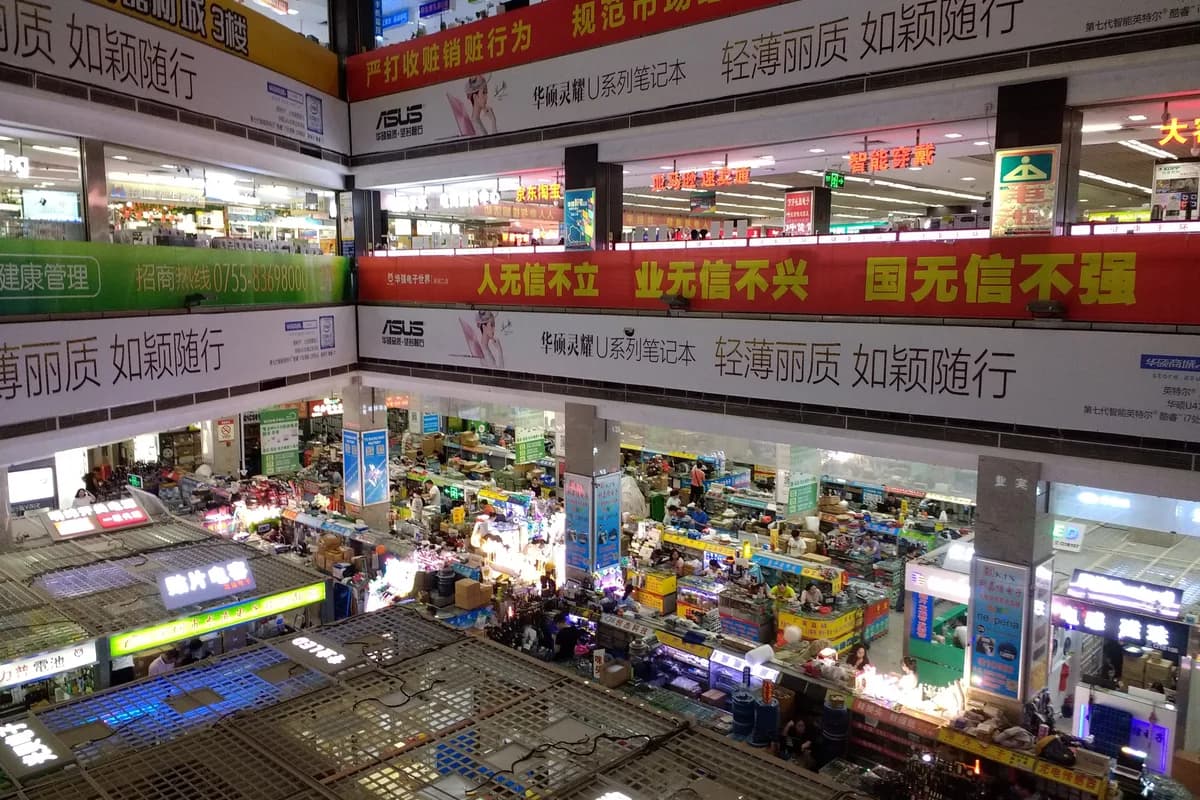
Every city has an electronics market. Tokyo has Akihabara. Bangkok has MBK. Shenzhen has Huaqiangbei (华强北) — and comparing any of them to Huaqiangbei is like comparing a swimming pool to the Pacific Ocean.
This is an entire district. Over 20 blocks of multi-story buildings, each crammed with thousands of vendors selling everything that runs on electricity or connects to a circuit board. Phone screens. LED strips. Drones. Security cameras. IC chips. Soldering tools. Raspberry Pi clones. Components so specialized you need an engineering degree to know what they do. And yes, phone cases — so many phone cases that the phrase "every phone case ever made" might actually be literal here.
The current official numbers are absurd: 35 specialized markets, roughly 115,000 business entities in the broader area, over 400 billion RMB in annual transactions, and about 7,000 overseas buyers passing through on a normal day.
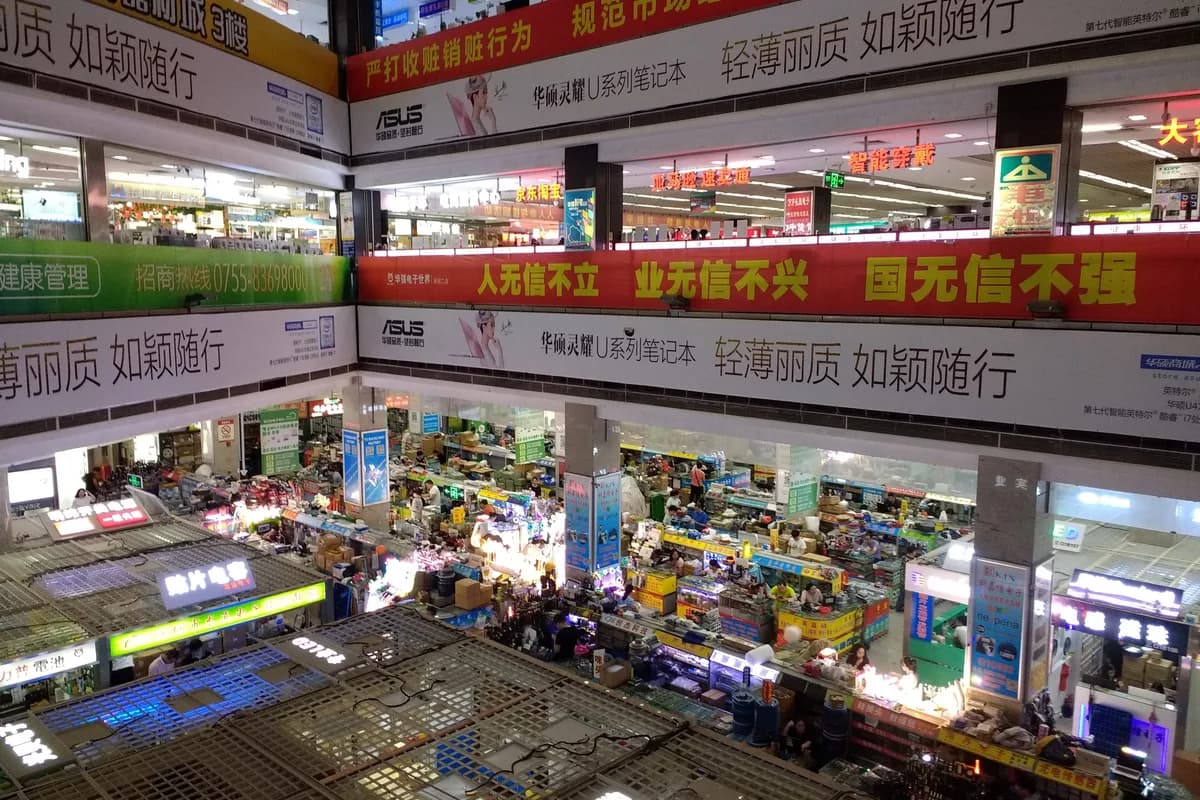
But here's what the sourcing guides and business articles miss: Huaqiangbei is genuinely fun to visit even if you're buying nothing. The sensory overload alone is worth the metro ride. And if you know which buildings to hit, where to eat between floors, and how not to get ripped off — it goes from chaotic to fascinating.
(Most guides online are written for procurement agents. This one is for you — the person who just wants to spend half a day wandering through the world's most concentrated tech bazaar and come out with a story, maybe a cheap USB-C cable, and a better understanding of where all this stuff actually comes from.)
The building-by-building guide
This is the part every other tourist article skips, and it is the single most useful thing I can tell you: Huaqiangbei is not one market. It is a dozen separate buildings, each with a different specialty. Walking into the wrong building first is like landing in the automotive parts warehouse when you wanted the Apple Store.
Here is what matters, in the order you should probably visit them.
SEG Electronics Market (赛格电子市场)
The original. The iconic one. SEG Plaza is the tall building that anchors the district — you cannot miss it from the metro exit. This is where Huaqiangbei started, and it is still the most competitive on price.
Ground floor and floor 1: Consumer electronics, finished products, phone accessories. This is the tourist-friendly zone — brand-name items, reasonable English, prices that respond to bargaining.
Floors 2–4: Components, dev boards, repair parts, tools. The vibe shifts hard here. Fewer tourists, more engineers with shopping lists. If you know what a 0603 capacitor is, you are in paradise. If you do not, you are in a very confusing warehouse.
Floors 5+: Wholesale territory. Prices drop but minimum orders appear. Signs start saying 只做外贸/批发 (export/wholesale only). You can still browse, but vendors lose interest fast if you are buying one of something.
The streets immediately surrounding SEG have dozens of cheap restaurants — congee, noodles, dumplings for 15–25 RMB. Good for a mid-browse reset.
(The upper floors are where prices get genuinely surprising. I have seen identical cables — same brand, same packaging — sell for half the ground floor price on floor 3. The elevator ride pays for itself.)
Huaqiang Electronic World (华强电子世界)
If SEG is the original, Huaqiang Electronic World is the tourist-friendly version. Four floors, better organized, wider aisles, more signage in English. This is where I send friends who have never been — the learning curve is gentler and you can browse without feeling like you stumbled into someone's supply chain.
Floor 1: Brand phones, tablets, smartwatches. More finished products here than raw components. Prices are close to retail but still lower than what you would pay overseas for Chinese brands.
Floor 2: Phone accessories, audio gear, power banks. The Bluetooth speaker selection is overwhelming in the best way — you can test-fire fifty different brands in twenty minutes.
Floor 3: Computer parts, networking gear, storage. If you need an SSD or RAM stick for a specific laptop, someone here has it.
Floor 4: Development boards, Arduino and Raspberry Pi ecosystem, maker tools.
(Huaqiang Electronic World is where to go if you want the Huaqiangbei experience without the Huaqiangbei chaos. The tradeoff: slightly higher prices than SEG, but a much smoother browsing experience.)
Yuanwang Digital Mall (远望数码城)
The phone capital of Huaqiangbei — and that is saying something. Yuanwang is one of China's largest phone wholesale centers, and the scale is hard to overstate. Floor after floor of mobile phones: new, refurbished, mainland brands, imports, units destined for Africa and Southeast Asia.
As a tourist, the spectacle is the draw. The transaction volume on a single floor here exceeds what most Western electronics retailers move in a month. Vendors have stacks of phones sorted by model and color, sealed and ready for shipping in bulk.
What to buy here: If you want an affordable Chinese-brand phone (Xiaomi, Oppo, Vivo, Realme) at mainland pricing, this is where to look. Test it, confirm it supports your home network bands, and bargain.
What to skip: Anything "refurbished" that seems too cheap. The quality control on refurbs varies wildly. If a phone looks brand new and costs 40% of retail, the screen is probably aftermarket.
Mingtong Digital City (明通数码城)
Phone accessories. That is the whole pitch. Cases, screen protectors, chargers, cables, mounts, holders, grips, ring lights — if it attaches to, protects, or accessorizes a phone, Mingtong has it. Multiple floors of it.
The variety is genuinely staggering. Every iPhone case design you have ever seen on Amazon was probably born within a two-block radius of this building. You can buy them here for a fraction of the Amazon price — we are talking 5–15 RMB per case instead of $10–15.
(If you want gifts for friends back home, this is the most efficient building in Huaqiangbei. Phone cases, cables, and power banks are light, cheap, and everyone uses them. Buy ten of the same cable for your whole office for the price of one at the airport.)
Huaqiang Plaza (华强广场)
The polished sibling. Huaqiang Plaza skews more brand-focused and consumer-oriented compared to the raw component buildings. Better lighting. Actual retail displays instead of cardboard boxes stacked to the ceiling. This is where the Chinese electronics brands maintain their flagship stalls.
Good for: brand-name purchases where you want the real product with real warranty. Less good for: bargain hunting or component shopping.
Pacific Security Market (太平洋安防市场)
An entire building dedicated to security cameras and surveillance equipment. IP cameras, CCTV systems, access control, facial recognition hardware, body cams, dash cams, and monitoring software.
This is a niche visit — but if you are into this category, nowhere on Earth has this concentration. The range goes from $8 doorbell cameras to enterprise-grade 64-channel NVR systems. Vendors can configure and test systems on the spot.
For a purchase, ask about the app, storage, power supply and whether the device will work in your home country.
LED International Lighting Center (华强北国际LED照明交易中心)
An entire building of LED strips, neon signs, LED controllers, pixel boards, and programmable lighting. If it glows, someone here sells it. Located on Huaqiang North Road alongside the other major market buildings.
Interior designers and event companies from all over Asia source here. As a tourist, it is mostly a visual spectacle — but if you have a project in mind (home LED setup, custom neon sign, pixel art board), you can spec it out and have it shipped.
(Walk through the LED building at the end of your visit, when your sensory tolerance is already maxed out. The sheer density of light in this place makes Times Square feel like a reading lamp.)
How to actually bargain here
Every generic travel guide says "bargain in China." Here is what that actually means at Huaqiangbei, building by building and floor by floor.
The ground rules
First price is never the real price — on non-branded items, vendors build 10–30% margin into the initial quote. Branded goods (Apple, Samsung, Sony) have tighter margins and less room to negotiate.
Ground floors cost more than upper floors. Ground-level stalls pay higher rent and deal with more walk-in tourists. The same product three floors up is often 15–30% cheaper because the vendor's overhead is lower and their customer base is wholesale.
Show that you know specs. If you are buying a power bank and you say "I want a 20,000mAh with 65W PD charging and USB-C," the vendor immediately recalibrates you from "tourist" to "someone who knows what they are buying." The price drops. If you say "I want a big power bank," you are getting the tourist price.
Pull up competitor screenshots. Walk to three stalls, note prices, then go back to the one you liked best and show them the lower price from the other stall. Vendors at Huaqiangbei hate losing business to a neighbor. This works better than any negotiation tactic.
The moves that work
-
Counter at 60–70% of asking price for accessories and non-branded items. If they say 100 RMB, offer 60. You will likely meet at 70–80.
-
Buy multiples. Even if you only want one cable, ask "what if I buy five?" The per-unit price drops, and you can split them as gifts. Vendors here are wired for volume.
-
Walk away. The oldest trick, and it still works. If the price is not right, say thank you and turn around. You will hear a revised number before you reach the next stall. (This does not work if the vendor is already at cost — you can tell because they will let you leave without a word.)
-
Test everything before you pay. Plug in that cable. Power on that speaker. Check that the camera actually records. Returns are functionally impossible at Huaqiangbei.
What not to do
- Do not bargain on branded items with sealed packaging — the margin is already thin and the vendor will just get annoyed.
- Do not counter with an insultingly low number (offering 20 RMB for a 200 RMB item). You will get ignored.
- Do not assume everything is fake. Huaqiangbei sells enormous volumes of legitimate products. The fakes are there too, but they are not the majority.
Spotting counterfeits
The obvious tells: spelling errors on packaging (Samsnug, Somy, Appel). Packaging that feels flimsy or prints blurry. Cables that claim 100W but use suspiciously thin wire. Stalls that refuse to let you test before paying.
The less obvious tell: price. A large discount is a reason to check the product carefully, not proof of either authenticity or fraud. Verify the exact model, condition, warranty and seller before paying.
The pedestrian street
Above the electronics chaos, Huaqiangbei has a pedestrian street (华强北步行街) that runs along the top of the district. During the day, it is a pleasant enough strip of shops, chain restaurants, and phone stores. At night, it transforms.
The light show
The buildings flanking the pedestrian street put on a nightly LED display. It is not the Futian Civic Center light show (that one uses 40+ skyscrapers), but it has its own charm — more intimate, more walkable, and you are standing directly underneath it instead of watching from a distance.
Times: Usually starts around 19:00–19:30 in winter, 19:30–20:00 in summer. Multiple cycles per evening.
The public piano
There is a piano sitting in the middle of the pedestrian street. No sign-up sheet. No bouncer. Anyone can sit down and play. On any given evening, you will see a random mix of: conservatory students practicing Chopin, grandmothers playing folk songs, teenagers doing anime soundtracks, and the occasional genuinely jaw-dropping performer who draws a crowd of two hundred.
This is one of the most purely Shenzhen experiences you can have. A city of migrants, all from somewhere else, sharing one piano on a street that sells phone cases by the million.
(If you play piano at all, sit down and play something. Nobody cares if you are good. The audience is generous.)
Huaqiangbei Museum (华强北博物馆)
A small museum documenting the history of the district — from its origins as a factory zone in the 1980s to its current status as the global hardware capital. Free entry but requires a WeChat reservation in advance. The exhibits are mostly in Chinese, but the photos and artifacts tell the story well enough.
Worth 30 minutes if you are already on the pedestrian street. Not worth a special trip.
Where to eat nearby
Huaqiangbei shopping is exhausting. Your feet hurt, your brain is fried from price comparisons, and you need fuel. Here is where to go.
包乐 Bread Lok
Hong Kong-style bread and pastries. The egg tarts are the move — buttery, warm, 6 RMB each. The pineapple buns are solid too. This is a quick refuel, not a sit-down meal. Multiple locations around the Huaqiangbei area.
首家刺瓜肠粉
Cucumber cheung fun (rice noodle rolls with cucumber — a Cantonese specialty you do not see in most cities). The stall is tucked in a side alley that you will not find without a map — search the Chinese name on Amap or Dianping. The cheung fun is silky, the cucumber adds a crunch that regular cheung fun lacks, and the whole thing costs about 15 RMB.
(This is the kind of place that food bloggers chase down and claim they "discovered" — but most tourists walk right past it. Follow the line of locals at lunchtime.)
紫荆城 building — import snack wholesale
Not a restaurant. This is a wholesale center for imported snacks from Japan, Korea, Southeast Asia, and Europe. You can buy Japanese Kit-Kats, Korean instant noodles, Thai dried mango, and German chocolate at bulk prices. Good for stocking up on travel snacks or gifts.
The building is a few minutes' walk from the main electronics strip. Prices are roughly 30–50% cheaper than import shops in Luohu or Nanshan.
Street food on the pedestrian street
The pedestrian street itself has a rotating cast of food stalls in the evening. Chuanr (grilled skewers), stinky tofu, egg waffles, fruit tea stands, and the usual Shenzhen street food suspects. Nothing here is life-changing, but it is cheap (10–25 RMB) and satisfying after a long day of building-hopping. Pair it with the evening light show.
For a proper sit-down meal, the streets immediately south of the pedestrian area have a solid cluster of Cantonese, Sichuan, and Hunan restaurants. Look for the packed ones at 18:00 — that is your quality signal.
Practical info
| Detail | Info |
|---|---|
| Hours | Most buildings: 9:00–18:00 or 19:00. Some stalls pack up by 17:00, especially upper floors. Pedestrian street stays lively until 21:00–22:00. |
| Best time | Weekday mornings, Tuesday through Thursday. Weekend crowds are brutal. |
| Metro | Huaqiangbei Station (华强北站) on Lines 2/7, Exit C — drops you right at SEG Plaza. Huaqiang Road Station (华强路站) on Lines 1/2 is slightly south, also walkable. |
| Address | |
| Payment | Alipay and WeChat Pay work at most stalls. Some smaller vendors still prefer cash for small purchases. Have both ready — see the payment guide. |
| Language | Vendors in the main buildings speak basic trade English: "How many? What price? Good quality." Beyond that, keep your translation app ready — essential apps guide. |
| VPN | Your VPN needs to be working before you arrive — Google Maps, WhatsApp, and foreign banking apps are all blocked. See the VPN guide for what actually connects in 2026. |
| Bring | A portable charger (you will drain your phone comparing prices and scanning QR codes). Comfortable shoes. A small backpack for purchases. |
| Skip | Sunday afternoons (some stalls close early) and national holidays (chaos). |
What NOT to buy
Honest advice, because nobody else writes this part.
"Brand name" items at 80% off: If someone is selling AirPods Pro for 150 RMB, they are not AirPods Pro. They might look identical, sound decent for a week, and then the Bluetooth cuts out permanently. The fakes have gotten incredibly good at the visual level — packaging, weight, even the serial number scan. But the internals are different.
USB drives with impossible capacity: A 2TB USB drive for 30 RMB does not exist. These are flashed to show 2TB but contain 32GB or 64GB of actual storage. Your files will corrupt the moment you exceed the real capacity. This scam has been running for a decade and it still catches people.
Anything you cannot test on the spot: If the vendor says "trust me, it works" but will not plug it in, walk away. Legitimate vendors at Huaqiangbei are happy to demo — they want you to see the product working because that closes the sale.
Bulk refurbished phones without inspection: Refurbs can be great deals, but you need to check: screen for dead pixels, battery health percentage, whether the chassis has been opened (check for misaligned screws or gaps). A good refurb is 30–40% off retail. A bad refurb is money in the trash.
What IS safe to buy: Cables, adapters, power banks, phone cases, screen protectors, Bluetooth speakers from known Chinese brands (Baseus, Anker, Ugreen — all have legitimate stalls here), LED strips, tools, and components. These are the items where Huaqiangbei genuinely offers the best prices on Earth, and the quality is consistent because the vendors are selling their own supply chain's output.
How Huaqiangbei fits into your Shenzhen trip
If you are doing the tech tour itinerary, Huaqiangbei slots into the afternoon. The DJI flagship and Nanshan tech corridor fill the morning, then you metro over to Huaqiangbei (Line 2 from Houhai area, about 20 minutes) and spend 2–3 hours building-hopping.
The ideal sequence: SEG Plaza (the essential, start here) → Huaqiang Electronic World (easier browsing, good comparison) → Mingtong (if you want accessories and gifts) → pedestrian street for food and the evening atmosphere.
After Huaqiangbei, the Futian light show at Civic Center is just two metro stops away on Line 2. Hit the electronics in the afternoon, grab dinner on the pedestrian street, and watch buildings light up. That is a complete Shenzhen evening.
Getting around: The getting around guide covers metro cards and navigation apps. You will want Amap (高德地图) loaded — Google Maps works with a VPN but Amap is more accurate for finding specific buildings and stall locations within Huaqiangbei.
Payments: Get Alipay set up before you come. Most vendors accept mobile payment, and showing a QR code is faster than counting cash. For the smaller stalls that only take cash, ATMs are scattered through the pedestrian street area.
Related guides
- Shenzhen Tech Tour — the full tech itinerary including DJI, drone delivery, robot taxis, and Huaqiangbei
- Payment setup — get Alipay and WeChat Pay working before you browse
- Getting around Shenzhen — metro cards, navigation apps, and how to not get lost
- Essential apps — translation, maps, and the other apps that make Huaqiangbei navigable
- VPN setup — get your VPN working before you need Google Maps at Huaqiangbei
- How to eat in Shenzhen — for when the Huaqiangbei food options are not enough
Change Log & Review CadenceExpand
Facts reviewed
Jun 17, 2026
Content updated
Sep 17, 2026
First published
Apr 10, 2026
Next review target
Jul 17, 2026