
Last verified Apr 10, 2026 · 18 min read
Direct answer
Nantou Ancient City (南头古城) is Shenzhen's old town: a 1,700-year-old walled settlement in Nanshan and the oldest urban site in Shenzhen, Hong Kong and Macau. People still live inside the walls, next to craft cocktail bars, indie coffee, ceramics studios and galleries. Free entry, open 24 hours.
- What it is: A 1,700-year-old walled settlement in Nanshan, the oldest urban site in Shenzhen, Hong Kong and Macau. Now a lived-in creative neighborhood with 14 bars inside the walls.
- Getting there: Metro Line 12 to Nantou Ancient City Station, Exit C. The south gate is directly in front. Free entry, open 24 hours.
- Best time: Arrive around 3-4 PM for the walk and the coffee, stay for the bars after dark. Bionic Brew is the craft beer anchor. Jifu Coffee has the 2019 China Barista Champion behind it.
This is not a tourist attraction
Nantou Ancient City (南头古城) is Shenzhen's old town: a 1,700-year-old walled settlement in Nanshan district. Every travel site that mentions it does the same thing — drops it into a "Top 10 Things to Do in Shenzhen" listicle with a one-paragraph blurb about "history" and moves on. That's not wrong, exactly. It just misses what's actually happening here.
Nantou is a neighborhood. People live inside these walls. Designers rent studios in buildings that predate the Song Dynasty. A guy who placed seventh at the World Barista Championship roasts Yunnan beans in a converted alleyway shop. There are 14 bars inside the ancient gates — cocktail bars, natural wine bars, a vinyl-themed hotel where you can drink, buy records, and sleep, all in the same building.
The walls themselves were built in 331 AD, during the Eastern Jin Dynasty. That's roughly the same era as the founding of Constantinople. Older than most European cathedrals. Older than the entire concept of England.
And on a Friday night, the alleys fill up with Shenzhen's creative class — architects, tech workers from Nanshan, art students — drinking craft beer against stone walls that have been standing for 57 generations.
That's the thing about Nantou. The history is real and the vibe is real, and the two exist in the same physical space without either feeling forced. It's not a theme park, and it's not a rebuilt "ancient town" with ropes around the old bits. It's a living neighborhood that happens to be 1,700 years old.
(If you only have time for one non-tech, non-shopping thing in Shenzhen, this is the one I'd pick.)
The history — quick version, not boring
Nantou was founded as a county seat in 331 AD, during the Eastern Jin Dynasty. The official name was 东官郡 (Dongguan Commandery), and it served as the administrative center for a massive coastal region that eventually became Shenzhen, Hong Kong, and Macau. This is not marketing — the Chinese government officially designates Nantou as "the origin of Shenzhen, Hong Kong, and Macau" (深港澳之源).
For most of the next 1,700 years, Nantou functioned as a garrison town and trading post. The Ming Dynasty built the stone walls and gates you see today — the ones in the photos — in the 1390s. The Qing Dynasty expanded them. The city processed sea salt, defended against pirates, and quietly served as the administrative anchor for the Pearl River Delta.
Then Shenzhen happened.
When Deng Xiaoping designated Shenzhen as a Special Economic Zone in 1980, the city exploded from a fishing village into a megacity in a single generation. Nantou got swallowed. By the 2000s, the ancient city was a 城中村 (chengzhongcun — "village in the city"): cramped apartments, cheap rent, migrant workers, and crumbling walls that most people walked past without noticing.
The renovation came in 2019-2020, led by a partnership between the Nanshan government and URBANUS, a Shenzhen architecture firm. The key decision: they didn't gut the neighborhood and rebuild it as a museum. They preserved the walls, restored the gates, cleaned up the alleys — and invited independent businesses in. Coffee shops. Galleries. Bars. Ceramics studios. A Starbucks with a rooftop terrace overlooking the ancient walls (ironic, but the view is genuinely good).
The result is something that feels organic in a way that most "historic districts" in Chinese cities absolutely do not. People still live here. The old residential buildings still stand alongside the new shops. You can walk from a Ming Dynasty gate into a cocktail bar in about eight seconds.
The walking route — timed and specific
Budget about 2-3 hours for Nantou old town if you're exploring casually. Longer if you're drinking.
Enter through the south gate (南门)
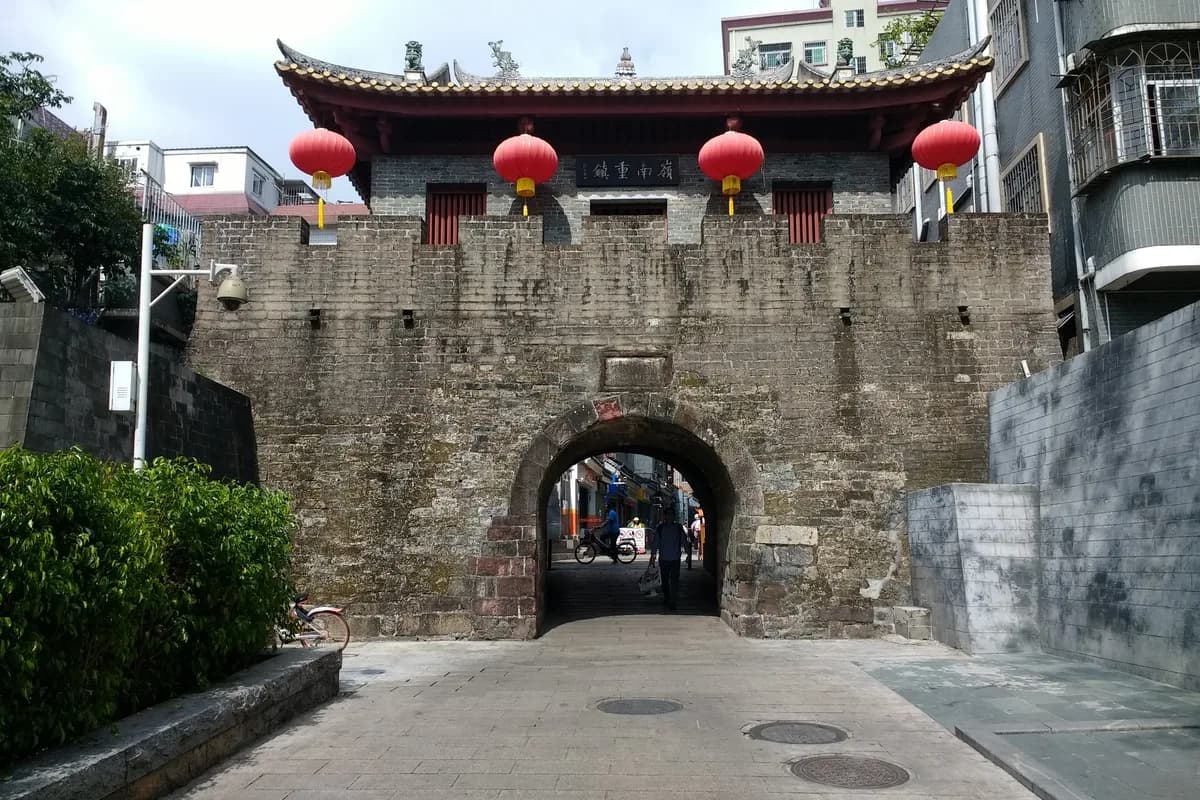
Metro Line 12, Nantou Ancient City Station (南头古城站), Exit C. Walk straight ahead — the gate is literally in front of you.
The south gate is the signature photo spot: a stone arch flanked by sections of the original Ming Dynasty wall. The wall is thick, weathered, and covered in just enough moss to look photogenic without looking neglected. Snap the photo, then walk through.
(On weekends this gate area gets crowded around sunset. If you want the photo without 40 people in it, come before 3 PM or after 9 PM.)
Main street — the first 10 minutes
The central street running north from the south gate is the commercial spine. This is where the indie shops cluster: ceramics, leather goods, handmade homeware, Chinese tea brands that actually look good, stationery shops that make you want to start journaling. Nothing here is cheap tourist trinkets — the aesthetic leans toward that Muji-meets-Jingdezhen design sensibility that Shenzhen's creative class gravitates toward.
There's a Starbucks Reserve about 200 meters in on the right. Normally I wouldn't mention a Starbucks in a guide about a 1,700-year-old city, but this one has a rooftop terrace with an unobstructed view across the ancient walls and courtyard rooftops. It opened in 2024 and the space itself is well designed — exposed brick, timber beams, the corporate mermaid kept tastefully small. Get your overpriced latte, take it upstairs, sit on the terrace for ten minutes. You'll see the entire layout of the ancient city from above, and it helps orient the rest of the walk.
Detour into the alleys
Turn off the main street into any of the narrow alleys branching east or west. This is where Nantou gets interesting.
The alleys are tighter, quieter, and older. The buildings here aren't renovated shops — they're the original residential structures, many still occupied. You'll see laundry hanging from balconies, old men playing chess in doorways, and patches of wall that look untouched since the Qing Dynasty. Street art pops up on corners — some commissioned during the renovation, some just... there.
These alleys are also where you'll find the Nantou Ancient City Museum (南头古城博物馆). It's small, free, and worth 20 minutes. The exhibits trace the city's history from the Jin Dynasty through to its life as a 城中村 before the renovation. The photography section showing what Nantou looked like in the 1990s and 2000s is striking — it contextualizes how dramatic the change has been.
The yamen ruins and north gate
About halfway up the main spine, look for the county yamen ruins (县衙遗址) — the remains of the original government seat that administered this entire stretch of the Pearl River Delta coast. This is the most historically significant specific site inside the walls, and it's the reason the Chinese government calls Nantou "the origin of Shenzhen, Hong Kong, and Macau." If you care at all about the administrative story of how one garrison town spawned three modern cities, stop here. There's signage in Chinese with some English, and the foundations are exposed enough to get a sense of the layout.
The north gate area has a different character from the south entrance. It's quieter, more residential, and there's less foot traffic from day-trippers. A few small eateries and a couple of the bars spill out this way, but the main draw is the absence of crowds — it feels more like the pre-renovation Nantou that longtime Shenzhen residents remember. Worth walking through even if you double back to the south end afterward.
A navigation hint for the alleys: the passages east of the main spine tend to be more residential and quiet, while the west side has more of the bar cluster.
Walk north toward the bars
The north end of the ancient city is where the nightlife concentrates. As you walk north, the vibe shifts: fewer homeware shops, more bar signage, more fairy lights strung between buildings. This is where you want to end up by late afternoon or evening.
Coffee in Nantou
集福咖啡 (Jifu Coffee)
This is the reason the specialty coffee crowd makes the trip to Nantou.
The owner, Du Jianing (杜嘉宁), won the 2019 China Barista Championship and placed seventh at the World Barista Championship the same year. That's not a participation trophy — seventh globally means he was competing against the best roasters in Scandinavia, Australia, and Japan. After the competition circuit, he opened Jifu in Nantou.
The focus is Yunnan coffee — Chinese-grown beans from Yunnan province, sourced directly from farmers. If you've only ever associated Chinese coffee with instant Nescafe packets, this will recalibrate your assumptions. The beans are excellent, the roasting is precise, and the dirty coffee (espresso poured over cold milk — it looks like it sounds) is the signature drink most people order.
The shop itself is small, tucked into one of the alleys off the main street. Expect a queue on weekends. Expect it to be worth the queue.
- What to order: The dirty coffee (脏咖啡) or whatever single-origin pour-over is on the menu that day
- Price: 28-48 RMB per drink
- Hours: 10:00-21:00 daily
Other coffee worth finding
Nantou has accumulated a solid cluster of specialty coffee shops — the renovation attracted the kind of independent operators who care about extraction ratios and latte art competitions. Beyond Jifu, you'll find 3-4 other specialty shops along the main street and side alleys. They rotate — some close, new ones open — but the general quality stays high because the rent selects for people who are serious about coffee rather than landlords running chains.
Walk the main street, look for shops with exposed espresso machines and single-origin bean lists on the wall. You'll find them.
Nantou bars — this is the real draw
If you asked me to name the single best bar-hopping neighborhood in Shenzhen, I'd say Nantou. Not Coco Park (too corporate), not Sea World (too expat), not Houhai (too bottle-service). Nantou has the density, the variety, and — critically — the setting. Drinking a cocktail inside walls built during the Ming Dynasty hits differently than drinking one inside a glass tower.
HK01 counted 14 bars inside the ancient city walls, and that number keeps growing. Here are the ones that matter:
Bionic Brew (百优精酿)
Shenzhen's own craft brewery, founded by Jenny Wang and Shawn Grover. The taproom inside Nantou is one of several locations, but the setting — stone walls, courtyard seating, ancient architecture overhead — makes it the best one.
The beer is legitimately good. Not "good for China" good — actually good. IPAs, stouts, wheat beers, seasonal rotations. They brew everything locally, and the quality has been consistent since they started.
- Hours: Mon-Thu 16:00-24:00, Fri 17:00-01:00, Sat 11:00-01:00, Sun 11:00-24:00
- What to order: Whatever IPA is on rotation — ask the staff what's new, they're proud of what they brew and happy to talk about it
- Price: 35-55 RMB per pint
VinylHouse (黑膠房子)
This one is hard to explain and easy to love. VinylHouse is a vinyl record shop, a bar, and a hotel — all in one building inside the ancient city walls. China's first vinyl-themed hotel, allegedly, and the claim is plausible.
The ground floor is the bar and record shop. Thousands of records on the walls, turntable playing, craft drinks. Upstairs are the hotel rooms — small, designed, each with a turntable and a curated selection of records. You can check in, drink downstairs, buy records, and fall asleep to whatever you picked.
Even if you're not staying overnight, the bar is worth a visit for the atmosphere alone.
- Hours: Opens around noon on weekdays, 10:00 on weekends. Closes at 02:00.
- Price: Drinks 38-68 RMB; rooms from around 400 RMB/night
公路商店 (Gonglushangdian / "The Road Store")
If you've spent any time in Chinese cities, you've probably already seen one of these. 公路商店 is a bar chain, but calling it a "chain" undersells the concept. The format: a small window in a wall. You buy a drink. You lean against the wall outside. You talk to whoever is standing next to you. No tables, no reservations, no pretense.
The Nantou location is particularly good because the "wall" you're leaning against might actually be 600 years old.
- Hours: 14:00-01:00
- Price: 15-35 RMB per drink
M Square Cocktail Company
A window-style cocktail bar with a twist: some drinks come as DIY kits where you do the final mixing yourself. It sounds gimmicky, but the base cocktails are well-made and the interactive element works in a group setting. Good for people who want something more creative than beer but less serious than a proper cocktail bar.
- Hours: 14:00-01:00
- Price: 38-58 RMB
The rest of the 14
Sip Up (西皮) — natural wine, which is having its moment in Shenzhen the same way it had its moment in Brooklyn five years ago. Small pours, interesting producers, knowledgeable staff.
Wu Ju (吴居) — cocktails in a quieter setting. Less of a scene, more of a "sit down and actually taste the drink" kind of place. Good for couples or small groups who want conversation volume below shouting.
There are more. Part of the fun is discovering them yourself as you walk the alleys — a lit doorway, a hand-lettered sign, music leaking out. The density means you can bar-hop without ever calling a Didi.
(What I'd do: start at Bionic Brew around 5-6 PM for a beer in daylight, then work your way through the alleys as the sun drops. By 9 PM the whole north end feels like a different city.)
Bionic Brew and VinylHouse have English menus or English-speaking staff. Most other spots don't, but a photo-order or point-at-the-wall approach works fine.
Food
Nantou is a better drinking neighborhood than an eating neighborhood, but there's enough to keep you fed.
Budget options
Hand-pulled noodles (兰州拉面) shops dot the side streets — standard, reliable, 15-20 RMB for a bowl. The hand-pulled noodle place just inside the south gate has a line by noon on weekends, and the line is earned — the broth is peppery and the noodles are pulled to order in front of you. Chaoshan rice noodle (潮汕粿条) spots are scattered around too. Boba tea shops outnumber both combined, because this is Shenzhen and every neighborhood has more boba than it needs.
The night food stalls appear after dark along the edges of the main street — grilled skewers (串串), fried rice, stinky tofu. Nothing fancy, but it's the right fuel for a bar crawl.
The Starbucks terrace (yes, really)
I already mentioned this in the walking route, but it bears repeating: the Starbucks Reserve rooftop terrace is a genuinely pleasant place to eat a sandwich and drink a coffee while looking out over 600-year-old rooftops. Is it ironic? Sure. Is the view good? Yes. Will you Instagram it? Probably.
Proper sit-down meals
If you want a real dinner before the bars, I'd suggest eating in the broader Nanshan area rather than inside the ancient city. The restaurant density inside the walls skews toward snacks and drinks rather than full meals. Nanshan's Taoyuan area (a 10-minute Didi ride) has excellent Cantonese restaurants, and Shekou has the Western options if you're feeling homesick. The full breakdown of what to eat in Shenzhen and how to order it covers all the QR code ordering tricks you'll need.
Art and exhibitions
Nantou has leaned into its identity as a cultural district, and several gallery spaces host rotating exhibitions throughout the year.
The exhibitions tend toward contemporary art, design, and photography — the kind of work that plays well against ancient stone walls and narrow alleys. During the Shenzhen-Hong Kong Bi-City Biennale of Urbanism/Architecture (UABB), which periodically uses Nantou as a venue, the entire city becomes an exhibition. Installations pop up in alleys, on walls, inside abandoned buildings. It's worth timing a visit around the biennale if you can.
Outside of biennale years, the gallery spaces still rotate shows every few months. Some are excellent, some are forgettable. Check the official Nantou Ancient City WeChat public account (南头古城) before you visit if you want to know what's on. Or just walk in blind and see what you find — the galleries are free and the worst case is you spent ten minutes looking at mediocre art in a beautiful building.
Workshops happen too — ceramics, calligraphy, printmaking. These are usually posted on the same WeChat account or announced on signs inside the ancient city. Most are in Chinese, but a few of the ceramics workshops have run English sessions.
Nantou Ancient City, Shenzhen: the practical details
How to get to Nantou Ancient City
Metro Line 12, Nantou Ancient City Station (南头古城站), Exit C. The ancient city gate is directly in front of you — you can't miss it.
Search for "南头古城" in Amap (高德地图) — Google Maps pins for this area are inconsistent and have sent people to the wrong gate.
深圳市南山区南头古城
Hours and cost
The ancient city itself is open 24/7 and free to enter. No tickets, no reservations, no QR code scan required. Individual shops, cafes, and bars have their own hours — most open by mid-morning and the bars run until midnight or later.
When to go
Arrive around 3-4 PM. This gives you daylight for the walking route, the alleys, and the museum. The light gets good for photos around 4:30-5 PM when the sun drops lower and the stone walls glow. Stay for sunset, then transition into the bar scene.
Weekday afternoons are quieter and better for photography. Friday and Saturday nights are better for the bar atmosphere — the alleys fill up and the energy shifts.
Avoid Chinese national holidays (Golden Week in October, Spring Festival in January/February) unless you enjoy being compressed into a human river moving at 0.5 km/h through a stone corridor.
Pair it with
- OCT-LOFT Creative Culture Park: 20 minutes away by metro (Line 1 to Qiaocheng East). Shenzhen's original creative district — galleries, design studios, bookshops, and a solid weekend market. The two make a natural full-day creative itinerary.
- Shenzhen Bay Park sunset: 15 minutes by Didi. If you leave Nantou around 5:30 PM and head to the bay, you can catch the sunset over the water with Hong Kong's skyline across the strait. Then Didi back to Nantou for the bars.
- The tech corridor: If art and history fill your morning, the Shenzhen tech tour — DJI flagship, drone delivery, robot taxis — fills the afternoon. Both are in Nanshan district, so the logistics work.
What to bring
Your phone with Alipay set up — almost every shop and bar takes QR code payment. A few of the smaller stalls take cash, but don't count on it. A portable charger, because your phone battery will not survive a 5-hour photo-and-bar session. A light jacket if you're going in winter — the alleys channel wind and it gets cold after dark between November and February.
Is it worth it? The honest answer
Nantou is not for everyone. If you want theme park history with English signage and audio guides, this isn't it. If you want a wild nightclub scene, this isn't it either. Nantou is for the kind of traveler who gets excited about drinking a well-made cocktail in an alley that's been there since the Ming Dynasty, who wants to browse ceramics made by a Jingdezhen graduate in a converted courtyard, who thinks the best parts of a city are the ones that layer centuries on top of each other without trying too hard.
If that's you, block out an afternoon and evening. You'll probably stay longer than you planned.
Getting back
The metro runs until about 11 PM (exact times vary by line and direction — check the Amap app for real-time last train info). If you're staying for the late bar scene, you'll need a Didi home. Rides from Nantou to central Nanshan or Futian typically cost 20-40 RMB depending on surge pricing. To Luohu or Shekou, expect 40-60 RMB.
Set up your transport apps before you come — you don't want to be figuring out Didi for the first time at midnight after three cocktails.
Questions
What is Nantou Ancient City in Shenzhen?
Nantou Ancient City (南头古城) is Shenzhen's old town: a 1,700-year-old walled settlement in Nanshan district and the oldest urban site in Shenzhen, Hong Kong and Macau. Since the renovation, people still live inside the walls, next to craft bars, coffee shops, galleries and independent stores.
How do I get to Nantou Ancient City?
Take Metro Line 12 to Nantou Ancient City Station (南头古城站), Exit C. The south gate is directly in front of you. Search 南头古城 in Amap rather than Google Maps, which has sent people to the wrong gate. Entry is free and the area is open 24 hours.
Is Nantou Ancient City worth visiting?
Yes, if you like your history lived in rather than roped off. Arrive around 3-4 PM for the walk and the light, then stay for the bars: 1,700-year-old walls next to craft cocktails and specialty coffee. Skip it if you want English audio guides or a nightclub.
What is there to do at Nantou Ancient City?
Walk in through the Ming Dynasty south gate, find the county yamen ruins and the free museum, drink a dirty coffee at Jifu Coffee, browse the ceramics shops, catch whatever exhibition is on, then bar-hop through the 14 bars inside the walls, starting with craft beer at Bionic Brew.
Change log and review scheduleExpand
Facts reviewed
Apr 10, 2026
Content updated
Oct 16, 2026
First published
Apr 10, 2026
Next review due
Jul 9, 2026
Did this actually work for you?