
By Stometa · Last verified · 11 min read
Direct answer
Things to know before visiting China: plan your route and offline contacts, then prepare for crowded metros, different toilets, unfamiliar payments and blocked apps.
- Safety: Keep your hotel address and emergency contacts offline, secure valuables in crowds and check current travel advice for your trip.
- Language: Expect zero English outside Shekou and international hotels. Translation apps are essential survival gear, not a nice-to-have.
- No tipping: Tipping does not exist in China. Staff will chase you down thinking you forgot your change. Say 谢谢 (xièxie) instead.
- Tap water: Never drink unfiltered tap water anywhere in China. Bottled water is cheap and available everywhere.
The China culture shock nobody warns you about
Most lists of things to know before visiting China do one of two things: they either paint everything in this rosy "ancient culture meets modern innovation" light, or they dump a list of dos and don'ts that reads like a corporate HR manual. Neither actually prepares you for your first 48 hours in Shenzhen.
This is the honest version of the things to know before going to China: the stuff that actually catches foreigners off guard — not because China is scary or bad, but because the gap between what you expect and what happens is wider than anyone admits. None of this is a dealbreaker. All of it is an adjustment. And knowing what's coming cuts the shock in half.
(If you're the kind of person who reads one guide before a trip, make it this one. The operational stuff — VPN, payments, apps — those have their own guides. This is about the human friction that no app can solve.)
Is it safe to travel to China?
Start with the practical risks you can plan for: getting back to your accommodation, keeping your belongings secure in crowds and having help contacts available offline. Check current travel advice for the places on your itinerary.
If you travel alone in Shenzhen, share your route with someone you trust and plan how to get home after dark. Keep your bag close on the metro.
Daily logistics also need preparation. Your usual apps may not work, and your card may fail at a QR-only counter. Read the VPN guide, the payment guide and the essential apps list before departure.
(The seven surprises below won't hurt you. They'll just make your first 48 hours stranger than they need to be.)
Personal space works differently here
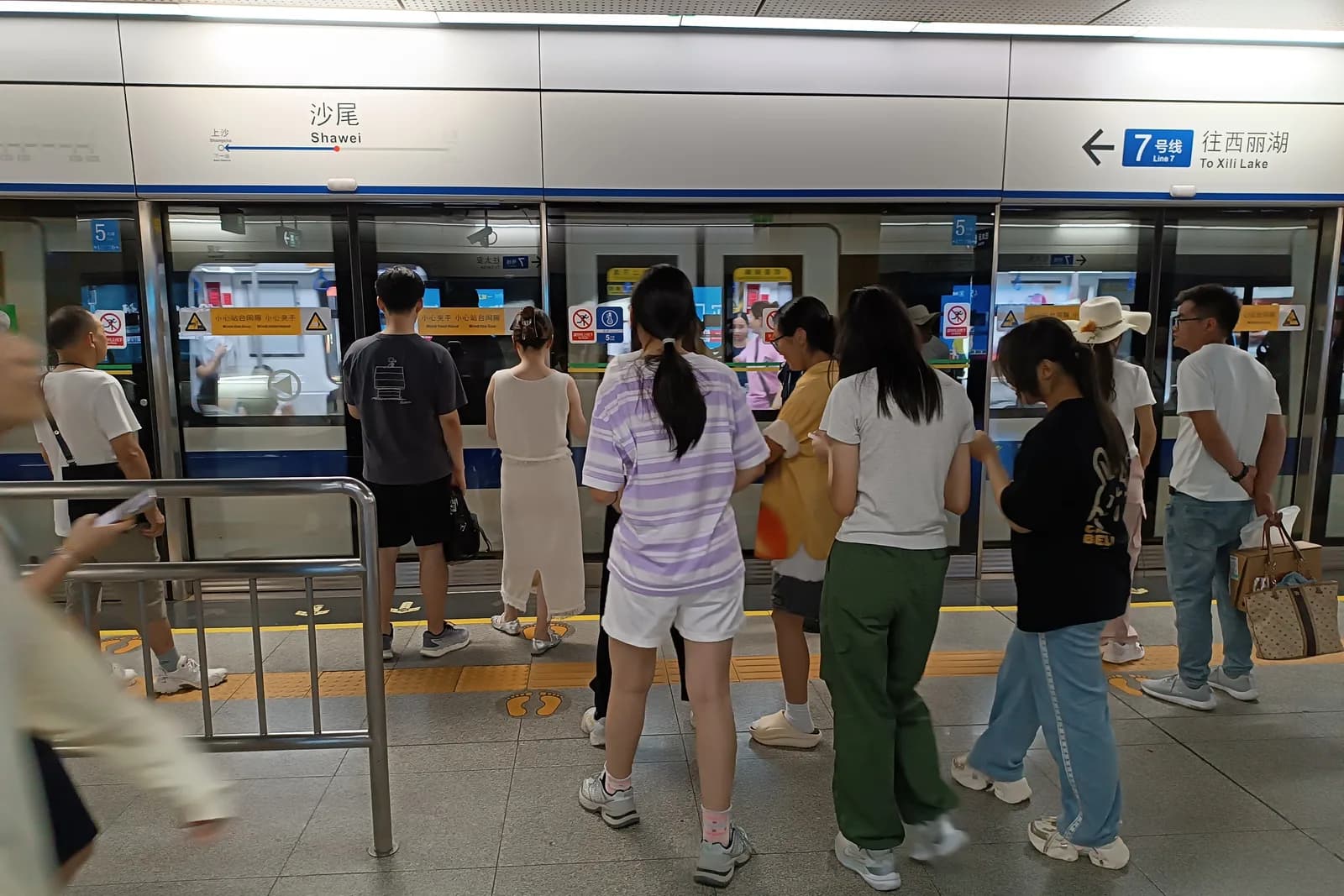
The first thing that hits you isn't the language or the food. It's the physical compression, and for most people it's the first real China culture shock.
In queues, on the metro, in elevators — people stand closer than you're used to. Bodies touch. If you leave a gap between yourself and the person in front of you, someone will fill it. Not aggressively, not rudely — it's just how 17 million people navigate shared space.
Metro boarding during rush hour is the one that really gets people. The doors open, and passengers push in before people have finished exiting. This is completely normal. Nobody is being rude. It's just physics at scale.
How to deal with it:
- Close all gaps in queues — a 30cm space is an invitation, not politeness
- Pre-position near the doors one stop before your exit, or you might not make it off in time
- Your bag makes a decent space buffer — hold it in front of you, not on your back
- Rush hour on Lines 1, 4, and 11 between 5:30 and 7pm is genuinely intense — avoid it if you can
(The Shenzhen metro is actually calmer than Beijing or Shanghai's — but it'll still surprise you if you're used to London or NYC spacing. Think of it as the mild version.)
People will stare at you
If you're visibly non-Chinese, you will get looked at. How much depends entirely on where you are.
In Shekou and Nanshan (the tech district, where many expats live): barely anyone notices. Foreigners are common. You're background noise.
In central areas like Futian or Luohu: occasional glances, sometimes a photo request, nothing intense.
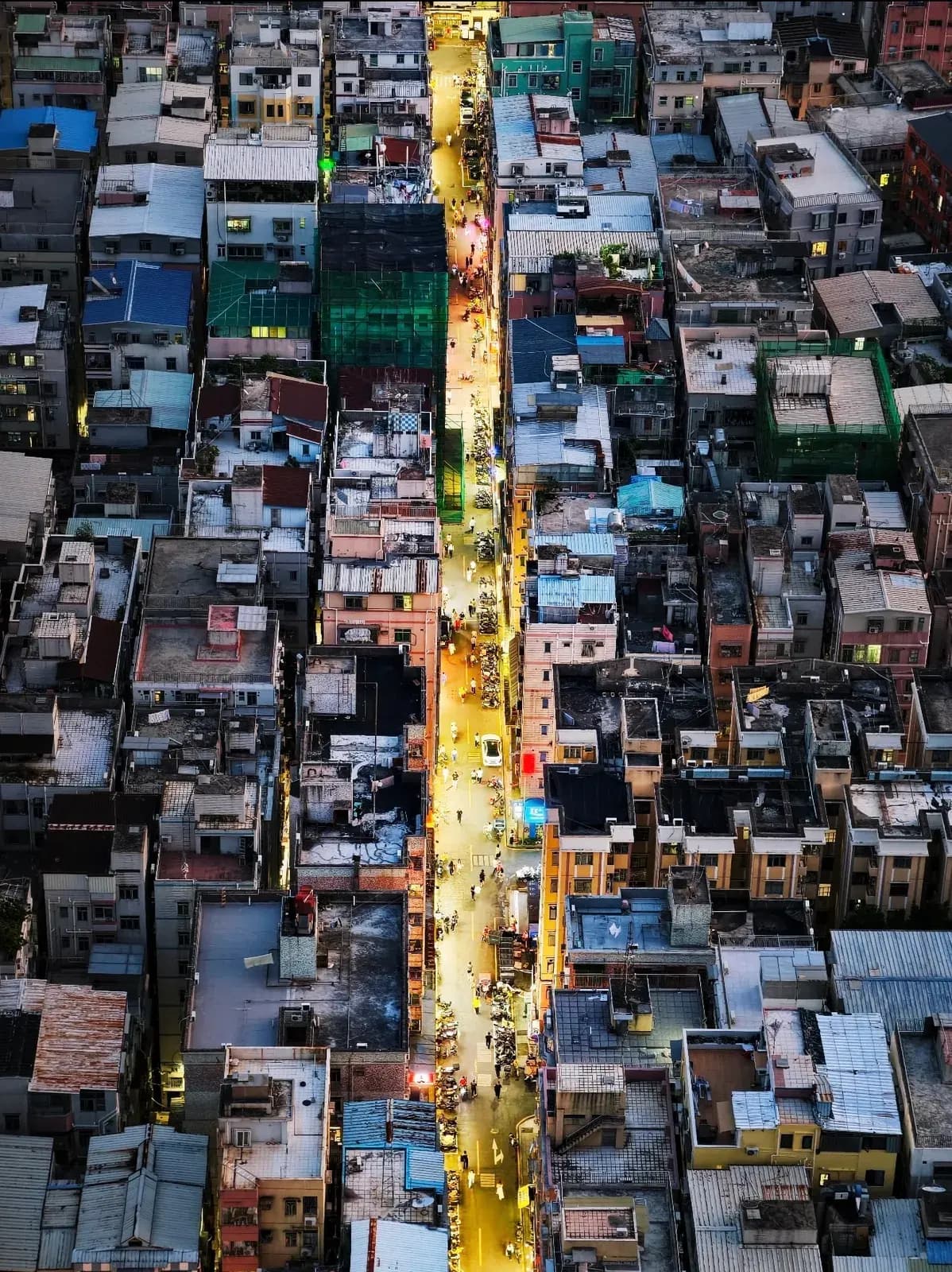
In 城中村 or east Shenzhen (Longgang, Pingshan, Dapeng): extended stares. Kids pointing. People pulling out phones for photos. Old aunties openly discussing you in Cantonese while you're standing right there.
Where you stay shapes what you see — the Shenzhen neighborhood guide breaks it down by trip type.
If the comments around you sound like half slang and half meme, keep the China slang decoder open. You do not need to understand every phrase, but knowing 大厂, 躺平, and 社恐 makes Shenzhen feel less like a wall of inside jokes.
Here's the thing — it's curiosity, not hostility. Almost always friendly. In smaller neighborhoods, a foreigner is genuinely unusual, and people are fascinated.
How to deal with it:
- Sunglasses help if it makes you self-conscious
- A wave usually gets a smile back
- Say 你好 (nǐ hǎo) and the moment becomes warm instead of awkward
- If someone wants a photo, it's genuinely because they think it's cool — say yes or no, either is fine
(The staring is way less intense in Shenzhen than smaller Chinese cities like Dongguan or Huizhou. If you've been to rural Southeast Asia, you already know the drill.)
The noise level is just... higher
This one creeps up on you. It's not one loud thing — it's everything being louder simultaneously.
Speakerphone conversations in public are normal and not considered rude. Your seatmate on the metro will FaceTime their mom at full volume. Videos play without headphones on buses. Construction starts at 7am and nobody complains. Restaurant volume makes Western "loud restaurants" feel like libraries — people shout across tables, music plays, the TV is on, the kitchen is open and clanging.
PA announcements blast through train stations, parks, and malls. Sometimes they loop. The Shenzhen metro plays safety messages on repeat that you'll have memorized within three days.
How to deal with it:
- Noise-canceling headphones are genuine survival gear, not a luxury
- Good earplugs for sleeping (construction doesn't care about weekends)
- Hotels with double-glazed windows are more important than you think — check reviews
- If restaurant volume bothers you, shopping mall food courts are paradoxically quieter than street-level restaurants
(Shenzhen is actually one of the quieter Chinese cities. Let that sink in.)
Toilets: the honest version
Nobody wants to write this section. But the first time you walk into a public restroom and there's no seat, no paper, and no soap, you'll wish someone had warned you.
Squat toilets still exist — especially in older buildings, 城中村, some metro stations, and bus terminals. They're clean enough, they work, and about a billion people use them daily. But if you've never used one before, it's a learning curve. (Tip: face the hooded end, keep your center of gravity low, and empty your pockets first.)
Western-style toilets are standard in modern malls (MixC, COCO Park, KK Mall), international hotels, airports, Starbucks, and KFC. Usually clean.
The paper situation: Carry tissues in your bag at all times. Dispensers are frequently empty. Some places have a shared roll outside the stalls — grab before you enter. Paper goes in the bin next to the toilet, not in the bowl. The plumbing in older buildings genuinely can't handle it.
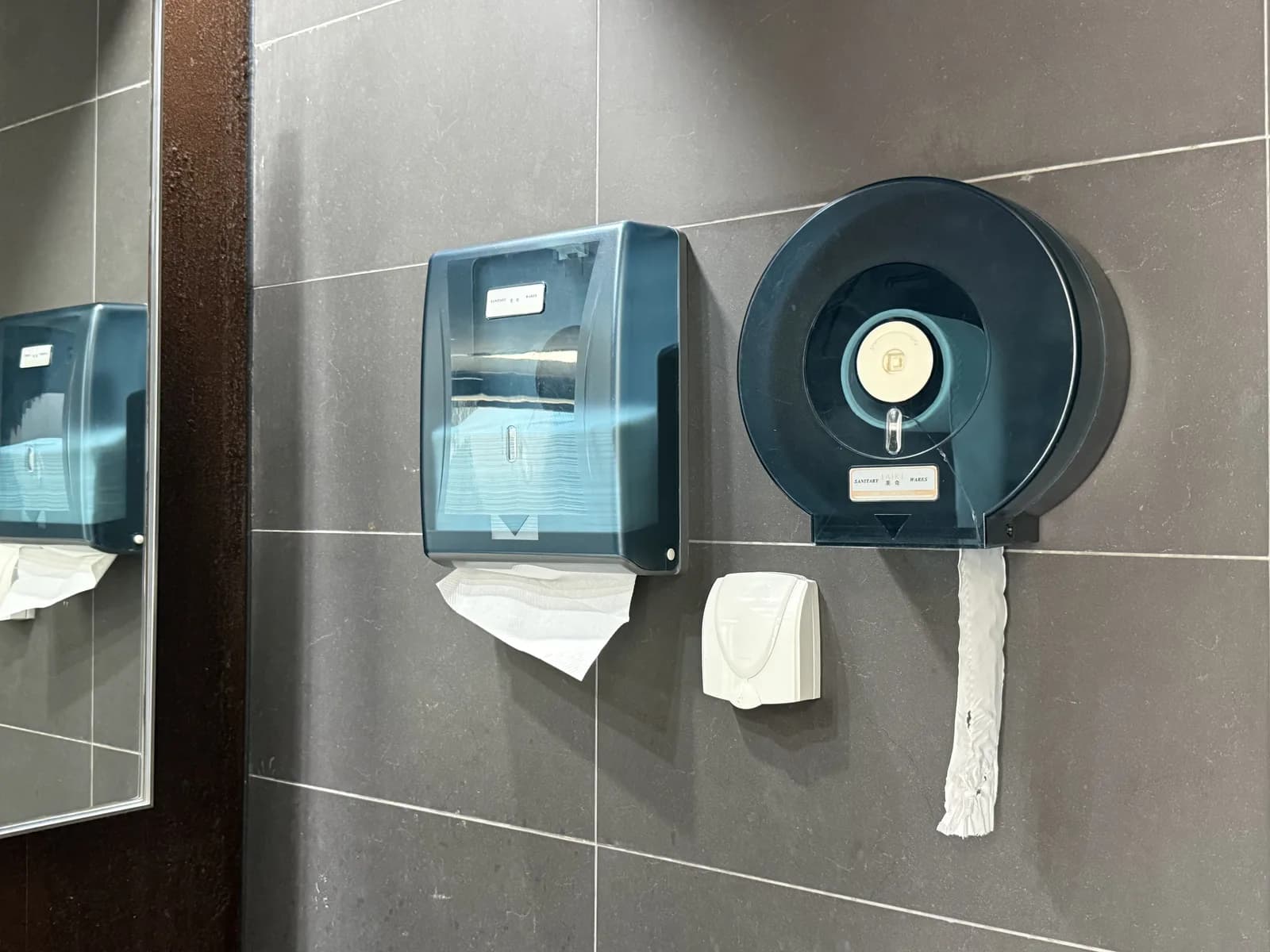
Hand sanitizer: Bring your own. Soap dispensers are empty more often than not.
Best public restrooms in Shenzhen: shopping malls (always), Starbucks (reliable), your hotel (obviously), KFC (surprisingly decent).
Worst: older metro stations, bus terminals, park restrooms in east Shenzhen.
No tipping in China. Seriously.
This is the easiest bit of China travel etiquette you'll learn, but it still feels wrong for the first few days.
Tipping does not exist in China. Not at restaurants, not for taxi drivers, not at hotels, not for haircuts, not for deliveries. Service is included in the price, always. There is no service charge line on the bill. There is no jar on the counter.
If you try to tip, the staff will almost certainly chase you down thinking you forgot your change. It's not that they're refusing — they genuinely don't understand what you're doing. Even in high-end international restaurants in Shekou where the staff speak English: no tip.
How to show appreciation:
- 谢谢 (xièxie) — thank you
- A genuine smile
- Coming back
That's it. No math, no awkwardness, no calculating 18% vs 20%. It's honestly refreshing.
Smoking is still everywhere
Indoor smoking bans technically exist in Shenzhen — and the city is stricter than most of China. But "stricter than most of China" and "actually smoke-free" are different sentences.
You'll encounter smoking in local restaurants (especially the smaller ones), some hotel lobbies in older buildings, basically any construction site, and sometimes in stairwells of apartment buildings. The guy at the next table lighting up during dinner is not breaking a social norm.
Reliably smoke-free: the metro (always), high-speed rail, airports, international hotel rooms, and major shopping malls. Chain coffee shops are usually fine.
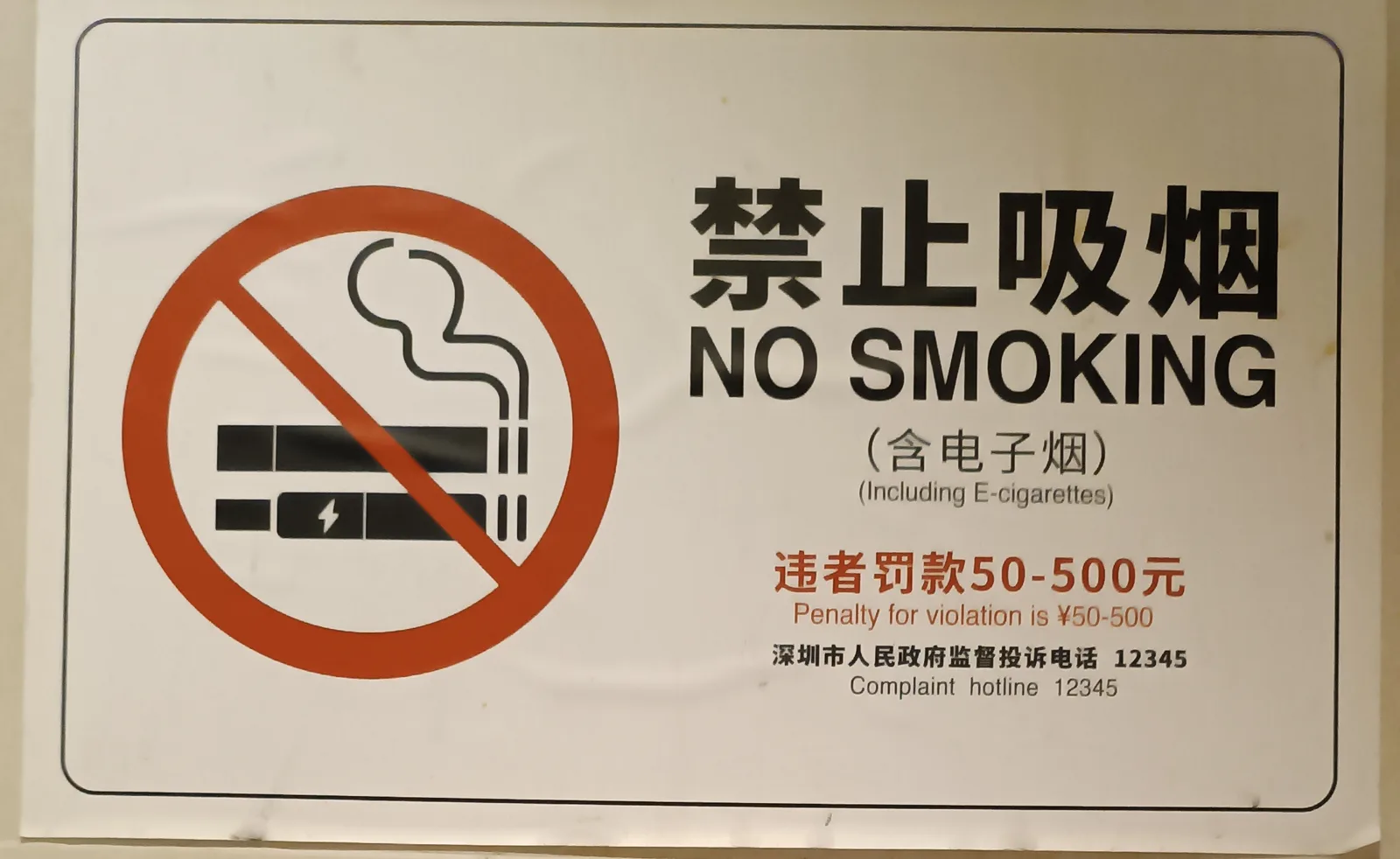
If you're sensitive to smoke:
- Request non-smoking rooms explicitly — don't assume
- Prefer chain hotels over boutique or older local hotels
- Eat in mall restaurants rather than street-level places
- Outdoor seating at cafes is usually the smoking section
(Shenzhen is genuinely better than most Chinese cities on this — the tech company culture helps. If you've been to other parts of Guangdong or further north, you'll notice the difference.)
The Great Firewall hits different in person
You know intellectually that Google is blocked in China. You've read about it. You've nodded along to articles about internet censorship. And then you cross the border and try to send a WhatsApp message and absolutely nothing happens, and it's still jarring.
If you came for the tech — DJI, robot taxis, Huaqiangbei — the tech tour guide tells you what is actually open to walk-ins and what requires booking ahead.
Here's what dies at the border:
- Google (Search, Maps, Gmail, Drive, Translate — all of it)
- WhatsApp, Instagram, Facebook, X/Twitter
- YouTube, Spotify, most Western news sites
- ChatGPT, Notion (intermittent), Slack
The switch from "everything works" to "half your phone is dead" happens instantly. One minute you're on Hong Kong Wi-Fi googling your hotel. The next minute you're staring at spinning circles.
How to deal with it:
- Have your VPN installed and tested BEFORE you arrive. This is not optional. Two VPNs is better — they go down at different times. Full setup in our VPN guide.
- Baidu Translate works without a VPN — it's your emergency fallback when the VPN drops
- Apple Maps works without a VPN (Google Maps does not)
- Download offline everything — Google Translate's Chinese pack, Amap's offline maps, anything you might need
- Tell people at home you'll be hard to reach. WhatsApp and iMessage (over data) may fail randomly even with a VPN
(The Firewall is the single biggest daily frustration for foreigners in Shenzhen. It's not a one-time setup — it's an ongoing thing you manage every day. VPNs slow down during political events, drop randomly, and sometimes just stop working for an hour. Accept this reality early.)
Quick reference: what to expect vs. what to do
| Situation | What happens | Strategy |
|---|---|---|
| Metro rush hour | Physical compression, pushing | Pre-position near doors, guard your space |
| Restaurant ordering | QR code menu, zero English | Google Translate camera mode |
| Public toilet | Squat toilet, no paper | Carry tissues everywhere |
| Payment | QR code only, card rejected | Set up Alipay first, carry cash backup |
| Navigation | Google Maps dead | Apple Maps or Amap (高德) |
| Communication | Zero English outside Shekou | Translation app + saved phrases |
| Noise | Speakerphone, construction, PA systems | Noise-canceling headphones |
| Smoking | Indoor smoking in local restaurants | Eat in malls, request non-smoking rooms |
| Internet | Half your apps blocked | VPN installed before arrival |
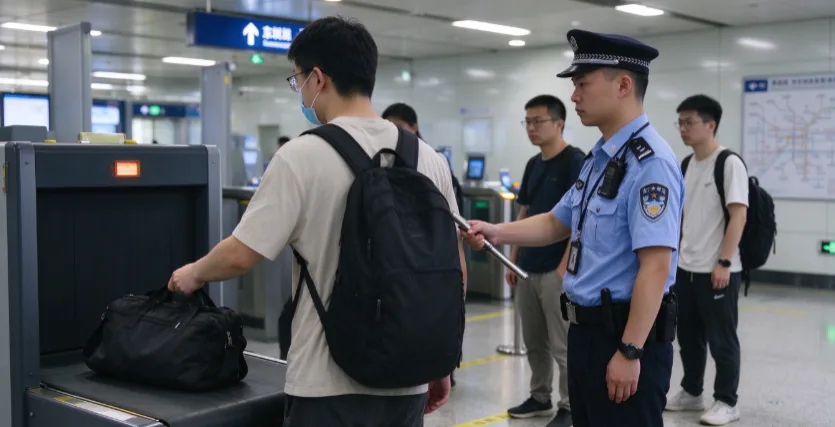
| Security checks | Every metro bag is screened; the operator’s July 20, 2026 notice allows up to 5 lighters and perfume or listed household flammables up to 700 ml each / 1,000 ml combined; loose or opened alcohol is prohibited | Check the operator’s limits (reproduced by Shenzhen Youth League) and what APEC 2026 changes in Shenzhen |
Related guides
Now that you know what to expect, handle the operational blockers:
- Arrival checklist — the step-by-step sequence that prevents first-day scrambling
- How to eat in Shenzhen — ordering food without Chinese is its own skill
- VPN setup guide — the firewall section above is the short version — read this for the full setup
Questions
Is it safe to travel to China?
Check current travel advice and keep your hotel address and emergency contacts available offline. In Shenzhen, prepare maps, payments and connectivity before departure so you can handle everyday arrival problems. Use normal city precautions throughout the trip.
Is Shenzhen safe for solo travelers?
Plan your route back to your accommodation, keep valuables close in crowds and share your itinerary with someone you trust. Check your government's current travel advice before you go.
Do people speak English in Shenzhen?
Very little outside of Shekou and Nanshan tech offices. Hotel front desks at international chains usually have basic English. Everywhere else — restaurants, taxis, metro staff, shops — expect zero English. Translation apps are essential, not optional.
Is tap water safe to drink in Shenzhen?
No. Never drink unfiltered tap water. Bottled water is cheap and available everywhere. Hotels provide boiled water or electric kettles. Ice in drinks at chain restaurants is generally fine, but avoid ice from street vendors.
What is the tipping culture in China?
Tipping does not exist in China. Service is included in the price. Attempting to tip can cause genuine confusion. Show appreciation with a smile and a thank you instead.
What should I wear in Shenzhen?
Whatever you want. Shenzhen is the most casual major city in China — flip-flops and shorts work everywhere except business meetings. Cover shoulders and knees if you visit a temple. Otherwise, nobody cares.
What is the best time to visit Shenzhen?
October to December. Summer is brutally humid (35 degrees plus monsoon rain from June to September), and Chinese New Year shuts half the city down. Autumn is warm, dry, and the parks are not packed.
Can I use a foreign debit card at Shenzhen ATMs?
Yes, at most Bank of China and ICBC ATMs — look for the Visa or Mastercard logo on the machine. Withdraw at least 1,000 RMB to make the foreign transaction fee worthwhile. Some smaller bank ATMs reject foreign cards entirely.
Change log and review scheduleExpand
Facts reviewed
Content updated
First published
Next review due
Jul 9, 2026
Image credits
- Passengers queuing closely at the platform screen doors on Shenzhen Metro Line 7 at Shawei Station: Yaui Jimdmei 2826, Wikimedia Commons, CC0.
- A Shenzhen no-smoking sign covering e-cigarettes, with a 50–500 yuan fine and the 12345 complaint hotline: ZHUOOSANGMEI SKY BLUE, Wikimedia Commons, CC BY-SA 4.0.


Did this actually work for you?