China Visa Free for Americans 2026 — 10-Day Transit
Can Americans travel to China visa free? Yes — 10 days via 240-hour transit. The Hong Kong trick, designated ports, and when your US passport needs an L visa.
Direct answer
Fast answer first, then the detail and edge cases below.
TL;DR
US passport holders can use China’s 240-hour transit policy only on a qualifying journey to a third country or region. Hong Kong–Shenzhen–Hong Kong does not qualify. Check your route and designated entry port before booking.
- Time limit
- 240 hours (10 days) from midnight the day after arrival. Immigration stamps the exact deadline in your passport.
- Check both sides of the journey
- The country or region immediately before mainland China must differ from the one immediately after it.
- Designated ports only
- For Shenzhen visits, the NIA list includes Bao’an Airport, Shekou and West Kowloon. It does not list Shenzhen Bay, Futian or Luohu for transit entry.
- When to check visa options
- A return trip to the same country or region does not qualify as transit. Check the visa category for your purpose and length of stay.
Not sure about your exact route? Run the visa checker first — 10 seconds, covers 90+ countries →
The deal for Americans (no sugar-coating)
Yes, Americans can visit China without a visa in 2026 — but not the easy way.
Here is the situation: Americans are not on China's 30-day visa-free list. Eligibility depends on your passport and the entry policy you use. A US passport is eligible for the transit policy, but that does not make an ordinary return trip visa-free.
What Americans can do is use the 240-hour transit visa-free policy — which gives you 10 days in China, no visa application, no fees, no consulate visits. Check the transit requirements before buying tickets; they differ from ordinary visa-free visits.
For a Shenzhen trip, the clean version is usually:
- Fly to Hong Kong.
- Enter mainland China through an official-safe TWOV port like West Kowloon, Shekou, or Bao'an Airport.
- Keep a confirmed onward ticket to a different country or region from Hong Kong, within the permitted stay.
- Do not treat Futian or Luohu like normal TWOV entry ports just because they are convenient.
That last point is the expensive mistake. Futian and Luohu are great ordinary crossings, but they are not the safe answer for an American relying on 240-hour transit entry. Shenzhen Bay is also absent from the current NIA list of designated transit entry ports. Do not plan to enter there under this policy. Use the border picker if you are choosing a Hong Kong-to-Shenzhen route and your entry rule matters.
This guide is the American-specific version. If you are not American, the general visa-free guide helps you distinguish the different entry policies.
Policy source: The NIA transit policy and port list, checked September 17, 2026, support the route and entry-port corrections below. This is not a guarantee of admission or a fresh check of every travel service mentioned here.
How the 240-hour transit works (the real explanation)
The policy says you must be "transiting through China to a third country or region." That sounds like it only works if China is a layover, but it is more flexible than that.
What "transiting" actually means in practice:
You are flying (or taking a train or ferry) from Country A, entering China, and then departing China to Country B. Country A and Country B must be different countries or regions. Look at the stops immediately before and after mainland China, not just where your entire holiday begins and ends.
This is why Hong Kong changes everything.
Hong Kong is a Special Administrative Region. For immigration purposes, it counts as a "third region." So your trip can look like:
- New York → Hong Kong → (cross border into Shenzhen) → fly out of Shanghai → home ✅
- Hong Kong → Shenzhen → Tokyo can meet the route condition.
- Chicago → Shenzhen Bao'an Airport → Beijing → Tokyo can meet the route condition, provided the itinerary stays within the permitted areas and time.
These examples illustrate the route condition only. Your passport, port, onward ticket and permitted stay still need to qualify.
What does not work:
- New York → Shanghai → New York does not meet the third-country condition.
- Hong Kong → Shenzhen → Hong Kong also does not meet it, even if you flew to Hong Kong from the United States.
The Hong Kong trick — step by step
Use this route only when your onward destination differs from the place you enter mainland China from.
Step 1: Book a flight to Hong Kong
Not to China. To Hong Kong. Hong Kong has its own immigration system — Americans get 90 days visa-free in HK with zero paperwork. Fly into HK, clear HK immigration, done.
Step 2: Cross the border into Shenzhen
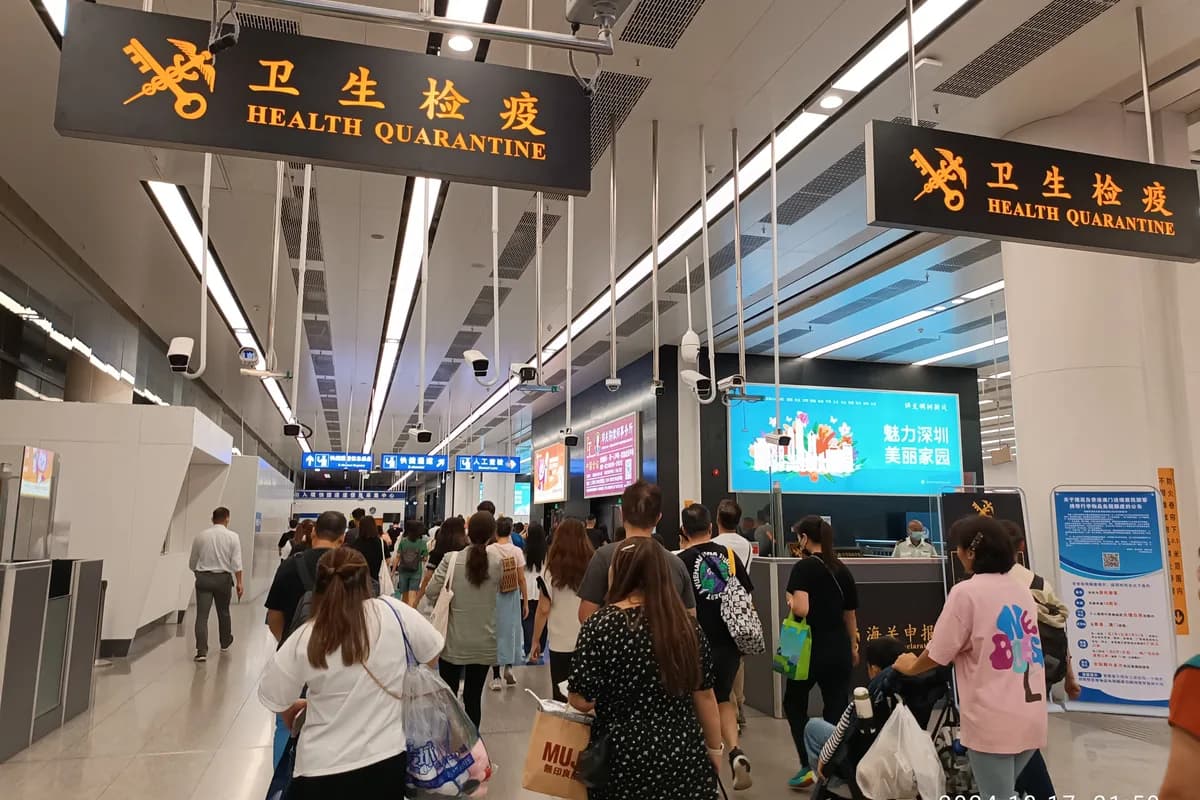
Choose a designated entry port, such as West Kowloon for high-speed rail or Shekou for a suitable ferry route. Confirm the actual service before booking. When you reach the Chinese immigration checkpoint, you will tell them you are using the 240-hour visa-free transit.
Important — you must use a designated port. More on this below.
Step 3: Do your thing in China
You have 240 hours. That is enough for a full Shenzhen trip, a weekend in Guangzhou, a train to Shanghai, or all of the above. You are not locked to one city — the policy covers 24 provinces across China.
Step 4: Leave mainland China
Follow the onward itinerary you used for your transit application. If you entered from Hong Kong, returning directly to Hong Kong does not make it a qualifying transit route. Confirm the exit port and permitted travel area for your itinerary.
That is it. Four steps. No visa application, no consulate appointment, no $140 fee, no 1-3 week wait.
The border crossings that actually work (and the ones that don't)
This is the part that trips up Americans in Shenzhen. Not all border crossings are designated transit ports for the 240-hour policy.
Designated entry ports (these work for TWOV) ✅
The NIA designates 65 ports across 24 provinces for 240-hour transit entry. For the Shenzhen area, the officially designated entry ports are:
| Port | How you get there | Notes |
|---|---|---|
| Shenzhen Bao'an Airport | Direct flight | If you are flying into Shenzhen, not HK |
| Shekou Ferry Terminal | Ferry from HK Airport / HK Macau Ferry Terminal | Good if you are coming from HK airport and skipping the city |
| West Kowloon Station | High-speed rail from HK | Chinese immigration inside HK station — added November 2025 |
| HK-Zhuhai-Macao Bridge | Bus from HK/Macau | Designated since 5 November 2025, but it lands in Zhuhai, not Shenzhen |
Not designated for 240-hour transit entry ⚠️
| Port | The situation |
|---|---|
| Futian (Lok Ma Chau) | The MTR crossing. Most convenient for many travelers, but not a designated transit entry port |
| Luohu (Lo Wu) | The classic MTR crossing. Same issue — not designated for entry |
| Huanggang | Not on the designated transit entry list |
| Shenzhen Bay | Not on the designated transit entry list |
Exit is different: You can leave China through any open port in Guangdong, including Futian, Luohu, Shenzhen Bay and Huanggang. The restriction is on which port you enter through.
Plan for the rule, not for anecdotes: NIA grants 240-hour entry only at the 65 listed ports (NIA port list). If you arrive at Futian or Luohu on this policy and are refused, you are sent back to Hong Kong to re-enter at a designated port.
(Use West Kowloon or Shekou. Both are officially designated and easy from Hong Kong. Do not plan to enter at Futian on this policy.)
Need help picking a crossing? Our border picker tool factors in your visa status →
What to bring to the border
| Document | Required? | Notes |
|---|---|---|
| US passport (valid 3+ months; 6+ is safer) | Yes | NIA says the travel document must be valid for at least 3 months. Airlines and old checklists still ask about 6 months, so do not cut it close |
| Onward ticket out of mainland China | Yes | Must show confirmed seat + departure time within 240 hours. A ticket to Hong Kong meets the destination condition only if you entered mainland China from somewhere else |
| Hotel booking | Helpful | Not always checked, but having it ready speeds things up |
| Digital arrival card | Strongly recommended | Fill out online before you cross: s.nia.gov.cn. Takes 5 minutes. Paper forms exist at ports if you forget |
| Return ticket to the US | No | They only care about your onward from China, not your trip home |
The airline check-in problem (this will happen to you)
If you are flying into a Chinese airport and claiming 240-hour TWOV at immigration, your airline's ground staff will almost certainly not know what the policy is.
This is the single most common friction point — not Chinese immigration (they process thousands of TWOV entries), but the airline check-in agent in your departure city who has never heard of it.
What happens: The agent sees "US passport, no Chinese visa" and tells you they cannot board you. You explain the 240-hour policy. They look confused. They call a supervisor. The supervisor has also never heard of it. You wait 20-30 minutes while they look it up.
The fix: Print a screenshot of the official NIA transit policy page showing the US is eligible. Have the URL ready on your phone. This is not about being right — it is about giving them something to reference so they can clear you without worrying about liability.
(If you enter via Hong Kong and cross the land border, this problem does not exist. HK airlines have no issue boarding Americans to Hong Kong. The TWOV conversation only happens at the Chinese border, where officers actually know the policy.)
How the 240-hour clock works
The math is more generous than you think.
The clock starts at 00:00 (midnight) the day after you arrive — not from the moment you clear immigration.
For example, if you enter through a designated port at 6pm on July 1:
- Clock starts: midnight July 2 (00:00)
- 240 hours = 10 full days
- You must depart by: 23:59 on July 11
Your actual time in China: closer to 246 hours in this example. Immigration stamps your passport with the departure deadline date, so there is no guesswork.
Follow the deadline granted by immigration. Leaving mainland China ends that entry; another admission is a separate decision and must independently meet the requirements.
Can you rely on another transit entry?
Do not plan a longer stay around repeated transit entries. Leaving does not guarantee another admission; each application must meet the route and other requirements.
If you need a longer stay or a different purpose of visit, check the relevant visa requirements before travelling.
Transit or a visa: choose for your actual trip
| Your plan | What to check |
|---|---|
| A short visit continuing to a third country or region | Whether every transit requirement is met |
| A return trip to the same country or region | The appropriate visa or another entry entitlement |
| A longer holiday | Tourist visa requirements and the stay granted on the visa |
| Business, work or study | The category appropriate to your purpose; do not assume a tourist visa covers it |
Check application procedures, fees and processing times with the Chinese embassy or consulate responsible for your application. Visa validity and permitted stay are separate: read the actual visa issued to you.
The stuff people get wrong
"I can enter through any border crossing"
No. Only designated transit ports. See the table above. Futian and Luohu are not designated.
"I can stay 10 days and then extend"
Plan to leave by the deadline granted by immigration. If you need a longer visit, arrange the appropriate visa rather than relying on re-entry.
"Visa-free means no paperwork"
Follow the arrival-card instructions for your entry. At a hotel, confirm reception has registered your stay. In a private home, you or your host must complete accommodation registration within 24 hours of checking in; agree the local procedure in advance. See the accommodation registration guide.
"The policy is permanent"
Check the current NIA policy before booking. Do not apply an expiry date from a separate visa-waiver scheme to the transit policy.
"I just need to show up"
You need a confirmed onward ticket departing mainland China within 240 hours. "I'll figure out my exit later" does not work at immigration. Book qualifying onward travel before you cross. A return ticket to the same country or region you arrived from does not satisfy the transit condition.
Official sources
The visa rules in this guide are sourced from:
- National Immigration Administration (NIA) — the only authoritative source for all visa-free and transit policies
- NIA 240-hour transit policy — 57 eligible countries, 65 designated ports, 24 provinces
- NIA visa-free entry expansion — unilateral 30-day visa-free list (which the US is NOT on)
- Chinese Embassy FAQ (updated Feb 2026) — US-specific Q&A on entry policies
The guide’s last whole-page verification remains June 17, 2026. The September 17 NIA source check specifically covers the transit route and entry-port corrections described above.
If you spot a discrepancy between our data and the official NIA page, let us know — include the relevant official source so we can check the correction.
Your next move
You know the rules. Now handle the practical stuff:
- Set up payments — Alipay is mandatory. Start the setup before you fly
- Pick your border crossing — West Kowloon or Shekou for TWOV entries
- Install a VPN — Do this in the US, not in China
- Run the full checklist — Everything from 30 days out to day one
Change Log & Review CadenceExpand
Facts reviewed
Jun 17, 2026
Content updated
Sep 29, 2026
First published
Mar 28, 2026
Next review target
Jul 17, 2026