
Last verified Jun 17, 2026 · 24 min read
Direct answer
A Shenzhen day trip from Hong Kong works: dim sum, Huaqiangbei, a foot massage, back by evening. For two or three days, give each day one district: Nanshan day 1 (culture + coast), Futian day 2 (skyline + food + tech), east coast day 3 (beaches + nature).
- Shenzhen day trip: Leave Hong Kong by 9am and cross at Futian Port or Luohu. Dim sum, Huaqiangbei, foot massage — back by evening. High-speed train: 14 minutes Futian to West Kowloon.
- How many days: Two to three days for highlights. One day works as a Hong Kong day trip. Four to five days lets you add Dapeng Peninsula beaches and deeper food exploration.
- Day 1: Nanshan: OCT-LOFT, Nantou Ancient City, Shenzhen Bay Park at sunset, Sea World — all in the same district to minimize transit time.
- Day 2: Futian: Lianhua Mountain Park, Huaqiangbei electronics market, Ping An Finance Centre observation deck, COCO Park for dinner and drinks.
Some links in this guide earn us a commission if you buy. See our affiliate policy.
Day trip, 2 days or 3? Pick two unless Shenzhen is your Hong Kong side quest
The honest answer: two days is the default Shenzhen itinerary. A Shenzhen day trip works if you are based in Hong Kong and just want dim sum, Huaqiangbei, and a foot massage before heading back. Three days is better if you want the east coast. Four or five days only makes sense if you are the kind of person who hears "Dapeng overnight" and gets excited instead of tired.
If you want to choose attractions before choosing days, start with what is actually worth doing in Shenzhen, then come back here to stop those picks from turning into a cross-city zigzag.
Do not plan Shenzhen like Beijing or Kyoto. There is no tidy old-town loop where every famous thing sits 12 minutes apart. Shenzhen is a working city stretched across districts, and the good version of the trip is choosing the right district each day, not collecting attractions like stamps.
| If you have... | Do this | Skip this |
|---|---|---|
| 1 day | Cross early from Hong Kong, eat 早茶, do Huaqiangbei, get a massage | Beaches, Sea World, anything that needs a long west-east transfer |
| 2 days | Nanshan on day 1, Futian on day 2 | Dapeng unless you like spending your trip in transit |
| 3 days | Add the east coast or Fairy Lake | Trying to squeeze Guangzhou in too |
| 4-5 days | Stay overnight in Dapeng or add Guangming | More mall-hopping just because Amap says it is nearby |
(If you have not set up Alipay, Amap, and your border plan, do those first. A beautiful itinerary is useless when the first metro gate does not open.)
If this trip is secretly a test run for moving here, keep the sightseeing plan on this page and open the Shenzhen cost of living guide for rent, deposits, and a realistic first-month cash number. Mixing a three-day hotel budget with a monthly apartment budget produces nonsense.
What to do in Shenzhen for 3 days: one district per day
That is the one rule that separates good Shenzhen itineraries from bad ones.
Shenzhen is 80km from end to end. The metro network is excellent — clean, fast, English signage — but the city punishes you for zigzagging. The mistake I see constantly: someone plans to hit OCT-LOFT in Nanshan, then Huaqiangbei in Futian, then Dameisha Beach on the east coast, all in the same day. That's three hours underground on a good day, and you'll see more metro tiles than skyline.
The 3-day plan below clusters everything by district. Day 1 stays in Nanshan. Day 2 stays in Futian. Day 3 goes east. You spend your time above ground, not transferring at Chegongmiao station for the fourth time.
(If you only have one day, use the Hong Kong day trip version below. It is not the deepest Shenzhen trip, but it avoids the nonsense version where you spend half the day transferring at Chegongmiao.)
Before any of this works, you need Alipay set up and Amap on your phone. Those two things are non-negotiable. Nothing in this guide — metros, restaurants, tickets, even convenience stores — works without them.
How many days in Shenzhen do you actually need?
| Days | What you can cover | Best for |
|---|---|---|
| 1 (HK day trip) | Dim sum + Huaqiangbei + foot massage | Hong Kong-based visitors with a free afternoon |
| 2 | Nanshan culture + Futian tech and food | Most first-timers — covers the essential Shenzhen |
| 3 | Above + east coast beaches | The sweet spot. Comfortable pace, no rushing |
| 4-5 | Above + Dapeng Peninsula overnight | Beach lovers, hikers, people who want to slow down |
Two days in Shenzhen is the minimum where you actually feel like you've been somewhere. One day is a sampler. Three days is where Shenzhen starts to click — you've figured out Alipay, you've stopped flinching at QR codes, and you can navigate the metro without checking the map every stop.
Shenzhen day trip from Hong Kong (1 day)
This is for people staying in Hong Kong who want to dip into Shenzhen without committing to an overnight. It works. You won't see the real depth of the city, but you'll eat well, experience the electronics chaos, and return with a sense of what you'd come back for.
Getting in
Cross at Futian Port (fastest, fully underground, directly on the MTR East Rail Line) or Luohu (closer to Dongmen if that's your first stop). Full port-by-port breakdown in the border crossing guide. If you're unsure which crossing fits your route, the border picker tool gives you a recommendation in 30 seconds.
Check your visa situation before you show up at the border — the visa checker confirms whether your passport qualifies for visa-free entry.
Leave Hong Kong by 9am. You'll clear immigration by 9:30-10:00, which gives you a full day. Cross any later and you're eating into your afternoon.
Morning: dim sum (早茶)
Get dim sum immediately after crossing. You're hungry, the restaurants near the border are excellent, and this is the single best food value compared to Hong Kong prices.
蘩楼 (Fanlou) near Luohu or 点都德 (Diandude) near Futian — both are proper Cantonese 早茶, not tourist versions. Expect to spend 60-80 RMB per person for a full spread. Har gow, siu mai, cheung fun, egg tarts, and congee. If you read nothing else about eating here, the food guide covers ordering without Chinese.
(The dim sum near Luohu is marginally better, but the dim sum near Futian means you're already on the metro toward Huaqiangbei. Pick based on which border you're crossing.)
Midday: Huaqiangbei electronics market (华强北)
Metro Line 1 to Huaqianglu Station (华强路站), Exit A.
This is the world's largest electronics market district. Multiple multi-story buildings packed with thousands of vendors. The scale is genuinely hard to describe — imagine if Akihabara and a wholesale warehouse had a child that grew to the size of a neighborhood.
What to do: Walk SEG Plaza and Huaqiang Electronic World. Browse 2-3 floors. Watch drone demos. Price out cables and accessories. Resist the urge to buy a "genuine" iPhone for 800 RMB.
What to actually buy: Custom cables, phone cases, chargers, camera accessories, LED lighting. The custom stuff is what Huaqiangbei does better than anywhere — sketch what you need on your phone and someone will quote you a price. The shopping guide has the building-by-building breakdown.
Budget 2-3 hours here. You could spend a full day, but for a one-day trip, this is about exploration and vibe, not serious sourcing.
Afternoon: foot massage + Dongmen
After Huaqiangbei, you're going to want to sit down. Walk east (or take the metro one stop to Laojie Station) to the Dongmen area for a foot massage. There are massage places every 50 meters. Budget 150-300 RMB for a 90-minute full-body or foot massage. Don't overthink the choice — any place with a clean lobby and more than three staff visible is fine.
While you're in the Dongmen area, walk Dongmen Old Street (东门步行街) — a pedestrian shopping zone with street food, budget clothing, and the chaotic energy that makes Shenzhen feel nothing like Hong Kong. Get chuanr (grilled skewers), changfen (rice noodle rolls), and bubble tea. 30-50 RMB feeds you.
Getting back to Hong Kong
Option A: High-speed rail from Futian (recommended)
Metro to Futian Station → HSR platform → West Kowloon, Hong Kong. 14 minutes. Costs 75-90 HKD. Buy tickets on Trip.com or at the station.
This is faster than re-crossing at the land border during evening rush hour, when the Futian and Luohu queues can stretch past 45 minutes. The HSR immigration is integrated — you clear both sides in the same building.
Trip.com
Book Mainland China high-speed trains in English without needing 12306 verification.
Foreign passports & cards accepted · E-ticket via passport
Train tickets on Trip.comOption B: Walk back across at Luohu or Futian Port
Works fine before 6pm. After that, expect queues. Friday and Sunday evenings are the worst.
Option C: Shekou ferry, if you finish on the west side
If you've swapped the eastern stops for Shekou or Nanshan, a city ferry to Hong Kong is another way back. It is not a sensible shortcut from Dongmen — you'd cross the city just to reach the terminal. Check the direction before booking: the package inspected on October 10, 2026 was Hong Kong → Shekou, so select a return sailing explicitly. This is a city ferry, not Hong Kong airport's airside transfer; check the terminals, sailing time and your entry documents separately.
Klook
City ferry tickets between Shekou and Hong Kong
Check your direction, terminal and sailing
Check availability on KlookDay 1: Nanshan — Culture, Coast, and Craft Beer
Nanshan is where Shenzhen stops feeling like a generic Chinese megacity and starts feeling like a place with a personality. The tech money flows through here, but so does the art scene, the coffee culture, and the waterfront life. Everything in today's itinerary is within the same district — no cross-city transit, no wasted hours underground.
Morning: OCT-LOFT Creative Culture Park (华侨城创意文化园)
Start here by 10am. OCT-LOFT is a repurposed industrial complex — think warehouses turned into galleries, boutique coffee shops, independent bookstores, and design studios. It's the closest Shenzhen gets to Williamsburg or Shoreditch, except the rents are lower and the coffee is better than it has any right to be. The OCT-LOFT Shenzhen guide is the one to open if you want the gallery-and-coffee version instead of just walking the main alley.
What to do: Walk the main alley, browse the rotating gallery exhibitions (usually free), sit with a coffee at one of the courtyard cafes, check the bookshops. If you're into photography, the light in the alley corridors between 10am and noon is excellent.
How long: 2-3 hours, depending on how slowly you drink coffee.
Getting there: Metro Line 1 to Qiaocheng East Station (侨城东站), Exit A. 5-minute walk. The getting around guide has the Amap setup if you haven't done it yet.
Lunch: eat within OCT-LOFT before heading to Nantou
OCT-LOFT has solid lunch options — noodle shops, small Cantonese restaurants, a few international spots. Nothing world-class, but convenient and honest. If you'd rather wait, Nantou Ancient City (your next stop) has better variety and more character.
Afternoon: Nantou Ancient City (南头古城)
Check the current route from OCT-LOFT to Nantou Ancient City. Line 12 serves 南头古城站; Taoyuan is an alternative arrival station, not one stop from Qiaocheng East.
Nantou is the oldest settlement in the Shenzhen area — a walled city that predates Shenzhen's existence by about 1,700 years. In the last few years it's been renovated into something genuinely interesting: narrow ancient alleys mixed with coffee shops, craft beer spots, independent galleries, and small restaurants. The renovation is tasteful, not Disneyfied.
What to do: Walk the main north-south alley, find Jifu Coffee (集福咖啡) for an afternoon pick-me-up, duck into the side alleys where the art installations and smaller shops hide. There's a small history museum near the south gate that's free and takes 20 minutes.
How long: 2-3 hours for a proper walk-through. Could be less if you're just passing through, could be more if you find a bar and settle in.
(Nantou at night is a different vibe — the bar scene picks up after 8pm and it becomes one of the better nightlife spots in Nanshan. If you're a night person, consider coming back after dinner.)
Late afternoon: Shenzhen Bay Park (深圳湾公园) for sunset
From Nantou, head south to Shenzhen Bay Park — a 13km waterfront promenade along the coast facing Hong Kong. This is Shenzhen's best free outdoor space. On a clear day you can see the Hong Kong skyline across the bay.
What to do: Walk along the coastal path. If you want a shared bike, test account verification, payment and the riding area first; do not make the afternoon depend on unlocking one. Head toward the Shenzhen Bay Bridge for the best sunset angle. The stretch between Shenzhen Bay Sports Center and the bridge is the most scenic.
Timing: Get here by 5:30-6:00pm for sunset (timing varies by season — check your phone). On weekends the park is packed but the path is long enough that it never feels claustrophobic.
Evening: Sea World or Nantou bar scene
Option A: Sea World (海上世界) A waterfront dining and entertainment complex in Shekou built around a decommissioned cruise ship. Sounds kitsch, but the restaurant row along the water is genuinely pleasant. International food, craft beer bars, a fountain show at 8pm (free). More polished and foreigner-friendly than most Shenzhen nightlife. Metro Line 2 to Sea World Station.
Option B: Return to Nantou for drinks If you preferred Nantou's vibe during the day, come back after 8pm for the bar scene. Smaller, more local, less chain-y than Sea World. Good craft beer options.
A different afternoon, if you'd rather be on the water: the Bay Area bridge cruise is a three-hour round trip from Shekou Cruise Homeport. Drop Nantou or the bay walk to make room, then eat around Sea World after returning; don't bolt it onto this already-full day. It is not a Futian light-show boat or transport into Hong Kong. Deck access depends on the weather, and the listing's refund windows were inconsistent when checked — confirm the chosen sailing's terms before paying.
Klook
A three-hour bridge cruise returning to Shekou
Check your sailing and package
Check availability on KlookWhy this order works
Everything stays within Nanshan. OCT-LOFT → Nantou → Shenzhen Bay Park → Sea World is a rough south-east to south-west arc, all reachable by short metro rides or 10-minute taxi trips. The afternoon light hits Shenzhen Bay Park perfectly for photos, and you end the day at a waterfront spot with food and drinks without any cross-city commuting.
Day 2: Futian — Skyline, Tech, and Food
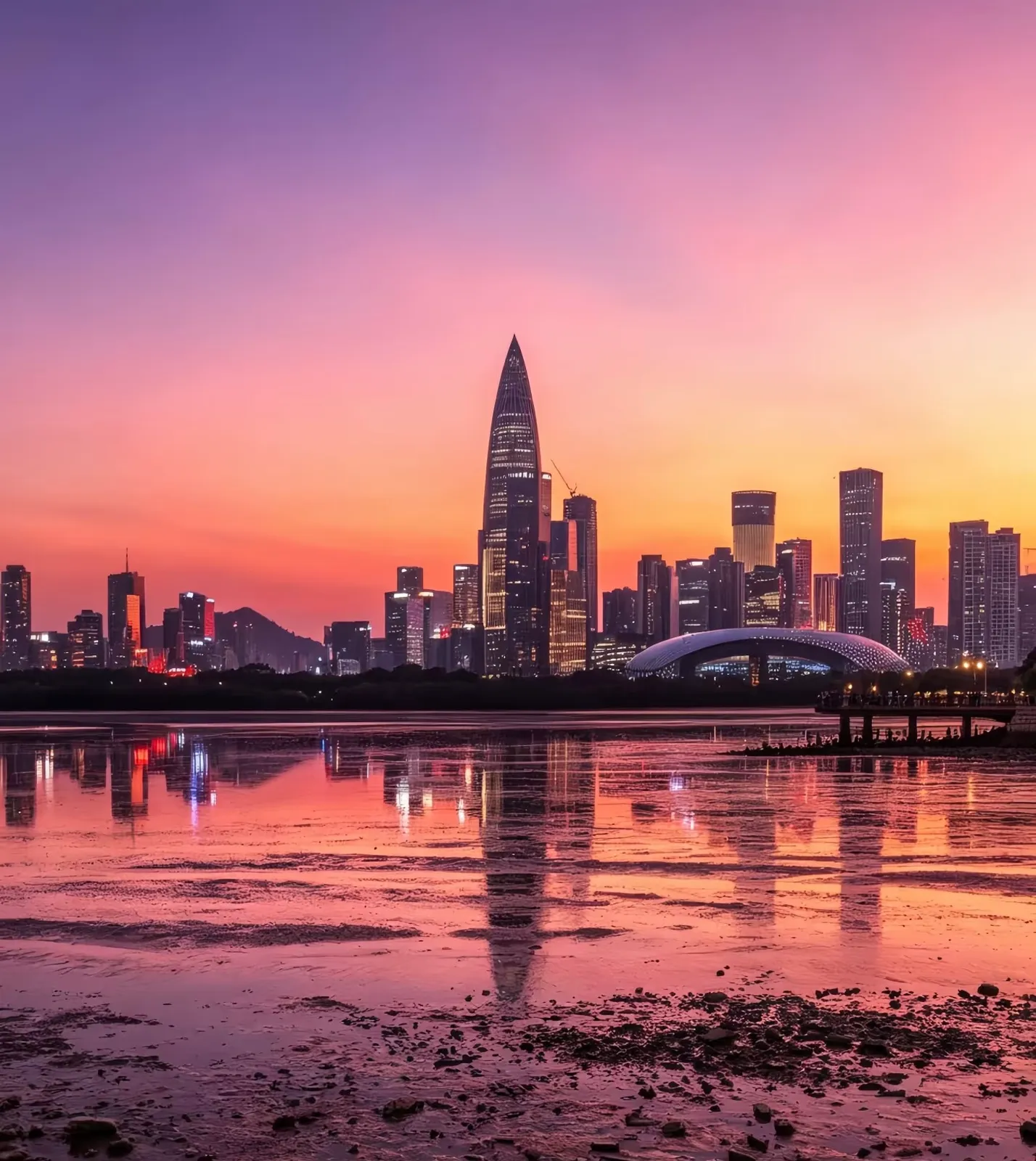
Futian is the CBD and the geographic center of Shenzhen. It's where the money is — literal and visual. The skyline is dominated by the Ping An Finance Centre (one of the city’s tallest buildings), the parks are manicured, and the food runs the full range from 15 RMB street noodles to 800 RMB omakase.
Today is more urban energy than yesterday. More vertical. More neon. More people.
Morning: Lianhua Mountain Park (莲花山公园)
Start early — the air is clearest before 10am and the morning walkers give the park a local energy you won't find later when the tour groups arrive.
Hike to the summit (15-20 minutes, paved path, easy) for the Deng Xiaoping statue and a panoramic view of the Futian CBD. This is the iconic Shenzhen photo — the modernist skyline laid out in front of you with Ping An Finance Centre towering above everything.
Free entry. Open daily. Metro Line 4 to Civic Center Station (市民中心站), Exit B — the park entrance is a 5-minute walk north. Alternatively, Line 9 to Shenzhen Library Station (深圳图书馆站) for the east side entrance.
Mid-morning: Shenzhen Museum + Civic Center (市民中心)
Walk downhill from Lianhua Mountain directly into the Civic Center area. The Shenzhen Museum of History is inside the Civic Center building — free entry, no booking needed, 1-1.5 hours.
The museum covers Shenzhen's transformation from a fishing village to a megacity of 18 million in 40 years. Even if you're not a museum person, the "before and after" photos of the Luohu skyline are genuinely striking. The speed of change here is hard to internalize until you see the 1980 photos.
Midday: Huaqiangbei (华强北)
If you didn't do the day trip version, this is your window. Metro Line 1 to Huaqianglu Station, Exit A. Budget 2-3 hours. The shopping guide has the floor-by-floor breakdown of what's where.
If you already did Huaqiangbei on the day trip, swap this block for the DJI flagship store at OCT Harbour in Nanshan (yes, it's technically leaving Futian, but it's worth it if you're into tech) plus the Bambu Lab experience store at Shenzhen Bay MixC. The tech guide has the full details on both.
Afternoon: Ping An Finance Centre observation deck (平安金融中心)
The fourth-tallest building in the world, 599 meters. The observation deck on the 116th floor is called "FREE SKY" — which is ironic because it costs 180 RMB. But it's worth it once. On a clear day you can see all the way to Hong Kong. On a hazy day you can see the floor below you and that's about it.
Check the horizon from street level first — if the surrounding towers disappear into haze (common in humid months), save your 180 RMB for a clearer day. The deck view in fog is 300 meters of white.
Buy tickets at the door or on Meituan. Meituan is usually 10-20 RMB cheaper. The visit takes about 1-1.5 hours including the queue and the elevator.
Getting there: Metro Line 1 to Shopping Park Station (购物公园站), Exit C. Walk 5 minutes.
Before or after Ping An, walk through the Gangxia North area near the station. The "Eye of Shenzhen" (福田星河COCO Park天幕) is a massive LED canopy over the pedestrian street — quick photo stop, takes 5 minutes, and you're already right there.
Evening: Coco Park area for dinner and drinks
COCO Park and the surrounding Gangxia area is Futian's main dining and nightlife cluster. The density of restaurants here is absurd.
For dinner:
- 八合里海记 (Bagelihaiji) for Chaoshan beef hotpot — the broth is simple, the beef is sliced to order, and the quality is consistently excellent. Budget 80-120 RMB per person. This is the Shenzhen dining experience I recommend most to first-timers after dim sum.
- Explore the basement food floors of any major mall — MixC, COCO Park, or KK Mall all have dedicated food levels with dozens of options ranging from Japanese to Sichuan to Korean BBQ. Point at what looks good.
More food strategies and QR code ordering survival tips in the eating guide.
For drinks: COCO Park has rooftop bars, speakeasies, and standard nightlife. Futian's bar scene is bigger and more varied than Nanshan's — less craft-beer-artsy, more cocktail-bar-and-KTV energy. The nightlife scene is covered in the culture guide.
Day 3: East Coast — Beaches and Nature
After two days of urban density, the east coast is a palate cleanser. Shenzhen has actual beaches — they're not Bali, but they're real, and the coastal scenery between Yantian and Dapeng is genuinely beautiful. The tradeoff: everything is 1-1.5 hours from Futian by metro or bus, so this is a full-day commitment.
Leave early. Whatever option you pick, aim to leave your hotel by 8:30-9:00am. The travel time eats into your morning otherwise.
Option A: Dameisha + Yantian Coastal Boardwalk (most accessible)
Best for: families, people who want a beach without the adventure, anyone who doesn't want to deal with buses.
Dameisha Beach (大梅沙海滨公园): Line 8 serves Dameisha Station (大梅沙站). Check the walking route from the exit to the beach entrance. Alternatively, bus from Futian Transport Hub or taxi/Didi from central Shenzhen (about 45-60 minutes). Free entry (reservation required via WeChat mini-program during peak season — search "大梅沙"). The beach is wide, the water is clean enough for swimming May-October, and the facilities are decent. Not a paradise, but a legitimate beach day.
After the beach, walk or taxi to the Yantian Coastal Boardwalk (盐田海滨栈道) — a scenic elevated walkway along the coast with mountain on one side and ocean on the other. Choose an open section and check access before setting out; you do not need to walk the whole coastline. The section between Dameisha and Xiaomeisha is the most scenic.
Lunch: Seafood restaurants line the road between the two beaches. Pick one with tanks out front and point at what you want. Budget 100-150 RMB per person for a proper seafood lunch.
Option B: Dapeng Peninsula (more rewarding, more effort)
Best for: hikers, photographers, people who want to see Shenzhen's wild side.
The Dapeng Peninsula is Shenzhen's eastern hook — a mountainous, less-developed area with some of the best coastline in the Greater Bay Area. It takes more effort to reach, but the payoff is a version of Shenzhen that most visitors never see.
Getting there: Bus E11 runs from Shenzhen North via Yinhu Bus Station to Dapeng. Check Amap for the live stop and departure time before leaving. Alternatively, taxi/Didi the whole way (~150-200 RMB).
Yangmeikeng coastal cycling (杨梅坑): Rent bikes at the village entrance (20-30 RMB/hour for a tandem, or use shared bikes) and ride the 5km coastal road along the cliffs — turquoise water, rocky coastline, minimal development. Go out and back: the second half has a real headwind coming home, so save legs. On weekends the tandems get picked clean by 10am — show up early or accept a regular bike.
Dapeng Fortress (大鹏所城): A 600-year-old walled military fortress, remarkably well-preserved. Free entry. Small museum inside. The fortress gives you a sense of the area's history before Shenzhen existed as a concept. Budget 1-1.5 hours.
Nan'ao seafood street (南澳海鲜街): The fishing village at the end of the peninsula. Pick a restaurant, point at the live seafood in the tanks, and eat. Fresher and cheaper than anything in the city proper. Budget 80-150 RMB per person.
More east coast details in the beaches and outdoors section of the culture guide.
Option C: Fairy Lake Botanical Garden + Hongfa Temple (nature without the commute)
Best for: people who want green space without the 90-minute bus ride, temple visitors, anyone with limited mobility.
Fairy Lake Botanical Garden (仙湖植物园): In eastern Luohu, 30-40 minutes from Futian by metro + taxi. Entry is 15 RMB. The garden is massive — 560 hectares of tropical and subtropical plants, walking paths through forests, a lake, and the Hongfa Temple sitting at the top of the hill.
Hongfa Temple (弘法寺): An active Buddhist temple inside the botanical garden. Free entry after garden admission. The incense, the chanting, the sudden quiet after days of urban noise — it's a genuine moment of calm. Go in the morning when fewer visitors are around.
Why this option: You get nature and stillness without the long commute. The botanical garden is a full morning. Pair it with an afternoon back in Luohu or Futian for shopping or a final meal.
4-5 Day Extension
If you have more time, the city opens up further.
Day 4: Dapeng Peninsula overnight
If you didn't do Dapeng on Day 3, this is the day for it. But instead of a day trip, stay overnight in Jiaochangwei (较场尾) — a beach village on the Dapeng coast with dozens of small guesthouses and hostels right on the water. Rooms run 200-500 RMB per night depending on season.
In the afternoon, do the Dong-Xi Chong coastal hike (东西涌穿越) — a 4-5 hour trail along the coast between two bays, with cliff-top ocean views, rock scrambling, and a finish at a quiet beach where you can swim. Go east to west: Xichong has actual buses and Didi coverage at the end, Dongchong does not. Wear shoes with grip (the wet rocks have ended trips for people in sandals), bring at least 2 liters of water, and don't start after 2pm — you do not want to be on the rope sections in fading light.
Day 5: Guangming District (光明区)
North-west Shenzhen, about 40 minutes from Futian on Metro Line 6. Guangming is the new frontier — the city is pouring money into science and culture infrastructure here.
Shenzhen Science Museum (深圳科技馆·新馆): A Zaha Hadid-designed swirl of curved glass and steel that opened in 2025 — the building alone is worth the metro ride. Exhibitions are better than they need to be, and most foreign visitors haven't found this one yet, so you can actually walk through the rooms instead of shuffling past phones held in the air.
Lunch: Guangming squab (光明乳鸽) The famous 光明招待所 (Guangming Guest House) has been serving roast squab since the 1980s. It's a Shenzhen institution. The squab is crispy-skinned, rich, and unlike anything you'll eat elsewhere in the city. Budget 60-80 RMB per person. Worth the trip to Guangming by itself.
Budget breakdown (all prices in RMB per person)
| Category | Budget | Mid-range | Premium |
|---|---|---|---|
| Hotel per night | 100-300 | 400-800 | 1,000-2,500 |
| Food per day | 60-100 | 100-200 | 200-400 |
| Transport per day | 10-20 | 20-50 | 50-100 |
| Attractions total | Mostly free | 200-400 | 500+ |
| 3-day total | ~800-1,500 | ~2,500-4,500 | ~5,000-10,000 |
Shenzhen is dramatically cheaper than Hong Kong across every category. A mid-range 3-day trip here costs less than two nights at a mid-range Hong Kong hotel. The budget tier is genuinely livable — you're not sacrificing comfort, you're just eating where locals eat and taking the metro instead of taxis.
The biggest variable is accommodation. Hotels near the border (Luohu, Futian) run cheaper than Nanshan or Shekou. The where to stay guide breaks down districts by price and convenience.
Practical tips that actually matter
Before you leave home
- Set up Alipay — this is not optional. It's the single thing that will ruin your trip if you skip it.
- Install a VPN — Google, WhatsApp, Instagram, and most of the internet you use daily is blocked in China. Install and test the VPN before you cross the border.
- Get an eSIM — reliable data the moment you cross. Don't depend on hotel WiFi.
- Download Amap (高德地图) — not Google Maps. Google Maps data in Shenzhen is wrong. Amap is accurate. Set it to English in settings. The essential apps guide covers the full app stack.
- Carry 500 RMB cash as a backup. Alipay occasionally fails for foreign-linked cards, and a few street food stalls and older markets are still cash-only.
Best months to visit
Best: March-May (spring, mild, occasional rain), October-December (autumn, dry, comfortable temperatures 18-25C).
Fine: January-February (cool, 12-18C, quiet), June (hot but pre-typhoon).
Avoid: July-September (typhoon season, 35C+, oppressive humidity), and the holiday weeks below.
Dates to avoid
- Golden Week (October 1-7) — the entire country travels simultaneously. Borders are chaos, attractions are packed, hotel prices double.
- Spring Festival / Chinese New Year (late Jan or Feb, varies) — the city empties as workers return home. Many restaurants close. The metro is quiet but the border crossings are war zones.
- Labor Day (May 1-5) — not as bad as Golden Week, but still heavy border traffic and crowded attractions.
- APEC summit week (around November 14-20, 2026) — not a holiday, but central Futian may see summit security and road closures at short notice. None had been announced as of October 9. The APEC 2026 Shenzhen guide tracks what is confirmed.
The arrival checklist
If this is your first time in Shenzhen, the arrival checklist sequences everything — VPN, eSIM, payments, apps, phone number — in the order you actually need them, starting 30 days before arrival. Read that first, then come back here for the day-by-day plan.
Questions
Can you do Shenzhen as a day trip?
Yes, from Hong Kong. Leave by 9am, cross at Futian Port or Luohu, then do dim sum, Huaqiangbei and a foot massage before heading back in the evening. The high-speed train from Futian to West Kowloon takes 14 minutes.
What should I do in Shenzhen for 3 days?
Give each day one district. Day 1 Nanshan: OCT-LOFT, Nantou Ancient City, Shenzhen Bay Park at sunset, Sea World. Day 2 Futian: Lianhua Mountain, Huaqiangbei, the Ping An Finance Centre deck, dinner around COCO Park. Day 3 the east coast (Dameisha or Dapeng) or Fairy Lake Botanical Garden.
How many days do you need in Shenzhen?
Two to three days covers the highlights. One day works as a Hong Kong day trip but you'll only scratch the surface. Four to five days lets you add the Dapeng Peninsula beaches and deeper food exploration.
What is the best area to start in Shenzhen?
Nanshan district on day one. It has OCT-LOFT, Nantou Ancient City, DJI flagship store, Shenzhen Bay Park, and Sea World — all within the same district, minimizing transit time.
Change log and review scheduleExpand
Facts reviewed
Jun 17, 2026
Content updated
Oct 15, 2026
First published
Apr 10, 2026
Next review due
Jul 17, 2026
Did this actually work for you?