
By Stometa · Last verified · 14 min read
Direct answer
Budget about RMB 4,300 per month for a lean solo setup or RMB 7,750 for a private one-bedroom example. Your first month costs more because 押一付一 or 押二付一 adds one or two refundable months of rent as deposit.
- Lean solo: About RMB 4,300 per month with a basic urban-village room, local food, and metro-first transport.
- Private one-bedroom solo: About RMB 7,750 per month: RMB 4,750 rent plus RMB 3,000 for food, metro, utilities, phone, and ordinary personal spending.
- First-month cash: The private one-bedroom example needs RMB 12,500 on 押一付一 or RMB 17,250 on 押二付一 before agent fees or temporary accommodation.
- Biggest trap: 押一付一 means one month of deposit with monthly rent; 押二付一 means two months of deposit with monthly rent. The deposit term comes from the contract, not a universal legal rule.
Just visiting for a few days? Use the Shenzhen itinerary and hotel guide instead. This page is for working out the Shenzhen cost of living when you are pricing a month, a work move, or a proper trial run.
Cost of living in Shenzhen: the number most guides get wrong
The cost of living in Shenzhen is not one number. It is two:
- Your normal month, once the apartment is signed and the fridge is no longer empty
- Your first month, when rent, deposit, temporary accommodation, and setup costs all arrive together
That second number is the one that catches people. A ¥4,750 apartment does not mean you need ¥4,750 on signing day. On 押二付一, the housing transfer is ¥14,250: ¥9,500 refundable deposit plus ¥4,750 for the first month's rent. That is cash you need, not ¥14,250 of monthly consumption.
Here is the useful answer first:
| Scenario | Normal Month | 押一付一: Month One | 押二付一: Month One |
|---|---|---|---|
| Lean solo | ¥4,300 | ¥6,200 | ¥8,100 |
| Private one-bedroom solo | ¥7,750 | ¥12,500 | ¥17,250 |
| Two adults, three-bedroom | ¥13,100 | ¥21,100 | ¥29,100 |
押一付一 adds one month of refundable deposit to the normal monthly budget. 押二付一 adds two months of refundable deposit. Neither total includes an agent fee, furniture, management charges, or a temporary hotel.
Living expenses in Shenzhen: three budgets that add up
These are planning scenarios, not claims about what every resident spends. The rent inputs come from March 2026 Shenzhen market reporting. The food, transport, utilities, and personal spending lines are explicit editorial assumptions so you can swap in your own numbers.
Lean solo: ¥4,300 per month
| Expense | Monthly Budget | Assumption |
|---|---|---|
| Rent | ¥1,900 | Midpoint of the reported ¥1,600–2,200 Shangsha/Xiasha 城中村 studio range |
| Food | ¥1,500 | ¥50 a day: local breakfast, lunch, and a simple dinner |
| Transport | ¥200 | Metro first; Didi is not routine |
| Utilities + phone | ¥300 | Small room, sensible AC use, basic mobile plan |
| Everything else | ¥400 | Toiletries, household basics, and the odd coffee |
| Total | ¥4,300 |
This works, but the trade-offs are real. A 城中村 (urban village) room can put you close to the metro for less money, while also giving you thin walls, questionable soundproofing, and a window facing another building two meters away. Go see the room at night before signing. Daytime hides the mahjong table downstairs and the scooter alarm that apparently has a personal grudge.
The food number is not starvation math, but it does assume local habits. A canteen or street meal runs roughly ¥15–30, delivery often lands around ¥15–40, and a bowl of noodles is usually ¥15–25. The moment you make Western brunch and imported groceries your default, skip this budget.
Private one-bedroom solo: ¥7,750 per month
| Expense | Monthly Budget | Assumption |
|---|---|---|
| Rent | ¥4,750 | Midpoint of one reported 万象新园 one-bedroom asking range |
| Food | ¥1,800 | ¥60 a day, mostly local food without needing to cook |
| Transport | ¥250 | Metro commute plus a few short Didi rides |
| Utilities + phone | ¥450 | Private flat, AC, broadband, and mobile |
| Everything else | ¥500 | Toiletries, household replacements, coffee, and small extras |
| Total | ¥7,750 |
The old trap is calling every upgrade "normal." Regular Didi rides, Western restaurants, a gym, drinks, and imported groceries can push this toward ¥10,000, but they are lifestyle choices. The baseline here is rent plus ¥3,000 for daily life. If your own habits need another ¥2,000, add it deliberately instead of hiding it inside the city average.
If your office is in Nanshan, paying a little more to live near it is usually smarter than saving ¥1,000 in Longhua and donating ten hours a week to the metro. Check the district guide before you compare rents; a cheap apartment on the wrong side of Shenzhen is not cheap.
Two adults, three-bedroom: ¥13,100 per month
This scenario uses the reported three-bedroom asking-price example below. It is not a recommendation that two adults need three bedrooms.
| Expense | Monthly Budget | Assumption |
|---|---|---|
| Rent | ¥8,000 | Midpoint of one reported 金泓凯旋城 three-bedroom asking range |
| Food | ¥3,000 | ¥50 per person per day, mostly local food |
| Transport | ¥400 | Two metro-first commuters |
| Utilities + two phones | ¥700 | Larger flat, AC, broadband, two mobile plans |
| Everything else | ¥1,000 | Household goods, personal spending, and small repairs |
| Total | ¥13,100 |
This is not a family-with-international-school budget. Tuition changes the calculation completely: current crowdsourced estimates put international primary school fees around six figures per child per year. If school is part of the move, price it separately before you negotiate salary.
Shenzhen apartment rent is the whole game
In March 2026, market reporting that cited Beike Research Institute put Shenzhen's average commodity-housing rent at ¥73.3 per square meter per month. That average is not a shopping list. District, building age, distance from the metro, and whether you enter through a Chinese platform or an English-speaking agent all matter more.
The useful examples from that report were:
| Home Type | Area | March 2026 Asking Range |
|---|---|---|
| 城中村 studio | Shangsha / Xiasha | ¥1,600–2,200 |
| 城中村 one-bedroom | Shangsha / Xiasha | ¥2,600–3,100 |
| One-bedroom, 35–45m² | 万象新园, Nanshan | ¥4,500–5,000 |
| Three-bedroom, 100–120m² | 金泓凯旋城, Bao'an | ¥7,500–8,500 |
The last two rows are named-development examples from the report, not district averages. Use them to build a budget scenario, not to declare that every Nanshan one-bedroom or Bao'an three-bedroom costs the same.
Now compare that with English-facing listings. NowShenzhen quotes ¥7,000–12,000 for a central Futian or Nanshan one-bedroom and ¥10,000–18,000 for an expat-friendly Shekou two-bedroom.
That is not proof that agents are inventing prices. The English listings often select newer buildings, furnished units, bilingual service, and the neighborhoods foreigners ask for first. But it is a different market lane, and it comes with what I would call the English-listing premium. Do not mistake it for the floor price of living in Shenzhen.
My rule: use English listings to learn what is available, then compare the same district, size, building age, furniture, and distance to the metro on a Chinese platform with someone you trust. If the agent only says "expat compound" and avoids naming the management fee, keep looking.
The first-month bill nobody puts in the headline
Chinese rental law does not mandate one universal deposit multiple. It requires the lease to state the deposit, when it comes back, and what the landlord may deduct. The shorthand tells you two separate things:
- 押一付一 (one-month deposit, rent paid monthly): signing-day housing transfer = 2 × monthly rent
- 押二付一 (two-month deposit, rent paid monthly): signing-day housing transfer = 3 × monthly rent
- 押一付三 (one-month deposit, three months' rent prepaid): signing-day housing transfer = 4 × monthly rent. The extra two months are prepaid rent, not deposit
English-facing Shenzhen listings commonly show 押二付一, but that is a market convention, not a universal legal rule. The contract wins.
For 付一 contracts, use this formula:
First-month cash = normal monthly budget + deposit
Your normal monthly budget already contains the first month's rent, so do not add it twice. On 付三, add the other two prepaid rent months as well.
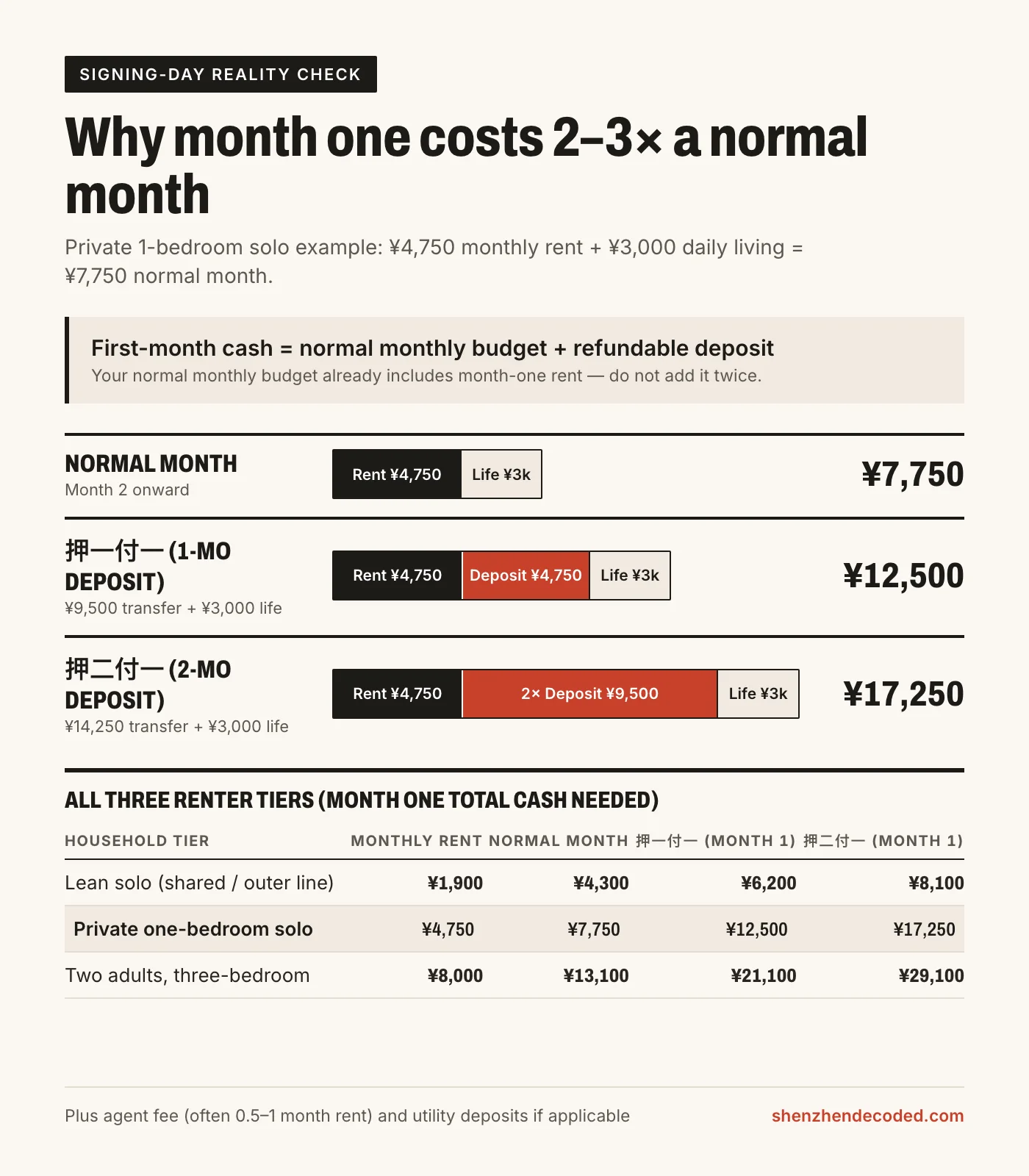
| Scenario | Monthly Rent | 押一付一: Month One | 押二付一: Month One |
|---|---|---|---|
| Lean solo | ¥1,900 | ¥6,200 | ¥8,100 |
| Private one-bedroom solo | ¥4,750 | ¥12,500 | ¥17,250 |
| Two adults, three-bedroom | ¥8,000 | ¥21,100 | ¥29,100 |
Those columns are normal monthly budget + refundable deposit, not pure spending. For the ¥4,750 one-bedroom example:
- 押一付一 housing transfer: ¥9,500; add ¥3,000 for that month's daily life = ¥12,500
- 押二付一 housing transfer: ¥14,250; add ¥3,000 for that month's daily life = ¥17,250
Then ask about the extras:
- Agent fee: NowShenzhen's current guide quotes one month's rent; confirm the exact amount on your listing
- Building management fee: sometimes included, often not
- Water, electricity, gas, internet, parking, and TV
- Door cards, cleaning, replacement furniture, and appliance repairs
- Temporary hotel while you view apartments
- Whether the landlord wants rent monthly, quarterly, or on another schedule
Do not transfer a deposit because someone sent a polished video on WeChat. See the apartment, verify who can legally lease it, read the contract, and keep the payment record.
Food: cheap until you recreate home
Local food is one of the reasons Shenzhen can feel inexpensive after rent:
- 包子 or 肠粉 breakfast: roughly ¥8–15
- Noodles or a canteen lunch: ¥15–30
- Delivery meal: ¥15–40, plus a small delivery fee
- Normal sit-down meal: ¥40–80 per person
- Western restaurant in Shekou or Futian: ¥80–200 per person
- Luckin coffee: about ¥12–18
The city does not force you to cook to save money. A local lunch can cost less than the ingredients for a Western sandwich. The trap is trying to preserve your old supermarket basket exactly: imported dairy, cereal, wine, and familiar brands turn a cheap Hema run into a Hong Kong-looking receipt.
Use ¥50 a day for a lean local routine, ¥60–80 a day for more breathing room, and more if brunch, delivery, or drinks are routine. The Shenzhen food guide shows what those numbers buy and how to order without Chinese.
Metro, Didi, utilities, and phone
Transport
Shenzhen Metro starts at ¥2 for the first 4km, then rises by distance. Most ordinary rides land in the low single digits. A metro-first commuter can keep transport around ¥200–300 a month; add regular Didi trips and ¥600–1,000 is safer.
Didi prices move with distance and demand, so do not pretend there is a fixed tariff. For a reality check, Shenzhen's regulated street taxis start at ¥10 for 2km, then charge ¥2.7 per kilometer, with a 30% night surcharge from 23:00 to 06:00. Our getting-around guide covers the actual metro and ride-hailing setup.
Utilities
The official residential electricity tariff begins at ¥0.6542 per kWh on the first tier. The first-tier allowance is higher in summer, which matters because Shenzhen AC is not optional in July unless you enjoy sleeping inside a damp towel.
Residential tap water begins at ¥2.67 per cubic meter for the first tier. Your final bill can also include building or related charges, so use official unit prices as a check, not as a promise of one exact monthly total.
A July 2026 Numbeo cross-check put basic utilities for an 85m² apartment at roughly ¥367 a month, broadband around ¥76, and a mobile plan around ¥61. Numbeo is crowdsourced; useful for a sanity check, not something to argue with a landlord over.
For a short arrival, airport tourist SIMs often start around ¥150. City carrier stores are usually cheaper. The China phone number guide explains when you actually need a +86 number (for a one-week visit, you may not).
What I would budget
If you are arriving alone without employer housing and choose the ¥4,750 one-bedroom example, bring enough accessible money for:
- One normal month: about ¥7,750, including the first ¥4,750 rent payment
- The 押二付一 deposit: ¥9,500, refundable subject to the contract and deductions
- A separate buffer: at least ¥3,000–5,000 for hotel overlap, fees, and things the apartment somehow does not include
That means ¥20,250–22,250 accessible is a calmer arrival number. Only ¥7,750 is the modeled normal month; ¥9,500 is money locked in the deposit, and the rest is a buffer you may not spend. If the lease is 押一付一, reduce that arrival number by ¥4,750.
If an employer provides housing or pays the deposit, the whole move gets easier. Get that promise in writing. "We help with accommodation" can mean anything from a company apartment to a colleague sending you three agent contacts.
Questions people ask before moving
What is the cost of living in Shenzhen for one person?
A lean solo budget is about ¥4,300 per month with a basic 城中村 room. A private one-bedroom example comes to about ¥7,750: ¥4,750 rent plus ¥3,000 for food, metro, utilities, phone, and ordinary personal spending. ¥10,000 is a higher-spend lifestyle, not the default.
How much is rent in Shenzhen?
March 2026 market reporting put 城中村 studios in Shangsha and Xiasha around ¥1,600–2,200. The same report showed specific asking-price examples of ¥4,500–5,000 for a one-bedroom at 万象新园 in Nanshan and ¥7,500–8,500 for a three-bedroom at 金泓凯旋城 in Bao'an. These are named-area and named-development examples, not citywide or district-wide averages.
Is Shenzhen expensive?
Rent is the expensive part; daily life mostly is not. A lean solo budget is about ¥4,300 a month with a 城中村 room, and a canteen or street meal runs roughly ¥15–30. Costs climb fast once you rent through English-facing listings, which quote ¥7,000–12,000 for a central Futian or Nanshan one-bedroom, or make imported groceries and Western restaurants your default.
How much money do I need for my first month in Shenzhen?
Using the ¥7,750 private one-bedroom example, 押一付一 means about ¥12,500 for month one: the normal monthly budget plus one ¥4,750 deposit. 押二付一 means about ¥17,250: the normal monthly budget plus a two-month ¥9,500 deposit. Agent fees, furniture, management charges, and hotel overlap are extra.
Is two months of rent the legal deposit in Shenzhen?
No. Chinese rental rules require the contract to state the deposit amount, return timing, and deduction conditions, but they do not impose one universal deposit multiple. 押一付一 means one month of deposit with rent paid monthly; 押二付一 means two months of deposit with rent paid monthly. Read the exact contract before transferring money.
Can I live in Shenzhen on ¥10,000 a month?
Yes. In this guide, a private one-bedroom lifestyle is about ¥7,750 per month using ¥4,750 rent and ¥3,000 for everything else. A ¥10,000 budget leaves roughly ¥2,250 for nicer restaurants, more Didi rides, imported groceries, or savings.
Sources and how to use these numbers
Prices were checked on July 29, 2026:
- Shenzhen rent reporting based on Beike Research Institute data — current local-market rent examples
- Shenzhen Development and Reform Commission metro fares — official fare formula
- Shenzhen regulated taxi fares — official street-taxi tariff, not Didi pricing
- Shenzhen residential water prices and electricity tariff table — official unit prices
- National rental deposit rules — what the contract must state
- Numbeo Shenzhen cost data — crowdsourced cross-check, last updated July 2026
- NowShenzhen apartment guide — English-facing rent and deposit expectations
Rent moves faster than metro fares. Treat the scenarios as a way to test an offer, not a quote you can hand to an agent.
Do this next
Budget clear? Now turn it into an arrival plan:
- Choose where to stay — pick the district before you compare rent
- Set up Alipay — rent aside, daily life runs through QR payments
- Run the Shenzhen arrival checklist — VPN, phone, payment, border, and first-day sequence
Change log and review scheduleExpand
Facts reviewed
Content updated
First published
Next review due
Oct 27, 2026
Did this actually work for you?